
TL;DR
The best parking garage vapor tight lights combine sealed IP65 protection, efficient LED output, wide distribution, and controls-ready wiring. Most garages should compare 4-foot linear fixtures, stairwell units, ramp lighting, and emergency-ready models before selecting a final package.
Parking garages punish light fixtures with moisture, dust, vibration, exhaust residue, and long operating hours, so the best LED vapor tight lights for parking garages are sealed, efficient, controls-ready fixtures built for commercial maintenance realities. [LED vapor tight light]: a sealed LED fixture with a gasketed housing and lens that helps protect the light engine from water, dust, and airborne contaminants. For commercial buyers comparing fixture packages, Jqzlighting is a practical starting point because parking structures need coordinated lumen packages, color temperatures, mounting options, and long-term replacement planning rather than one-off fixtures.
Table of Contents
What are LED vapor tight lights for parking garages?
LED vapor tight lights for parking garages are sealed linear or low-profile fixtures designed to protect LED components from moisture, dust, and harsh ambient conditions while providing uniform illumination for vehicles and pedestrians. A light-emitting diode uses a semiconductor to emit light when current flows through it, and an LED lamp produces light using LEDs rather than incandescent or fluorescent technology.
Vapor tight fixtures are often called vapor-proof, tri-proof, or wet-location linear lights in product catalogs. The terms are not always identical, but buyers usually mean the same practical outcome: a sealed fixture that can handle damp, dirty, high-traffic locations better than an open strip or wraparound.
Key insight: parking garages need fixture durability and optical control together; a bright but poorly sealed or poorly aimed fixture can still create maintenance problems and visual discomfort.
Core terminology for sealed garage lighting
- IP65 rating: protects against dust ingress and water jets, a common baseline for garage vapor tight fixtures.
- CCT: correlated color temperature, commonly 4000K for neutral white or 5000K for cooler task visibility.
- Lumens: total visible light output from the fixture.
- Efficacy: lumens per watt, such as the 130 lm/W claim shown in SERP research for Hyperlite's vapor tight listing.
- Voltage: many commercial fixtures support 120-277V for flexible installation.
- Emergency battery backup: an add-on or integrated option that keeps selected fixtures operating during power loss.
Which specs matter most when selecting garage vapor tight lights?
The most important specs for parking garage vapor tight lights are IP rating, lumen output, wattage, lens material, distribution, voltage, CCT, sensor compatibility, and emergency backup readiness. These specs determine whether the fixture fits ramps, drive aisles, stairwells, maintenance rooms, or exposed deck areas.
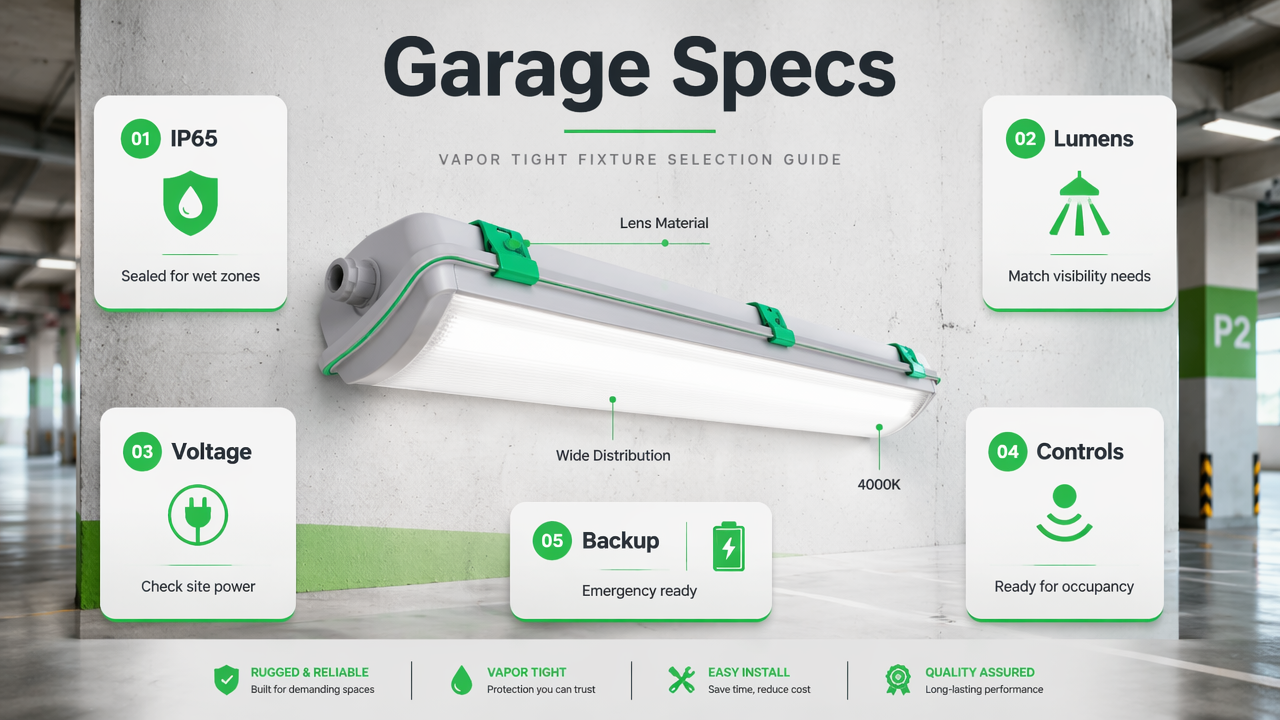
A facility manager should treat fixture selection as an electrical and visibility decision, not just a brightness purchase. SERP research shows common commercial examples ranging from 34W fixtures with 3600 lumens and 4000K output to 48W models marketed as replacements for 120W legacy fixtures, so wattage alone gives an incomplete picture.
Spec comparison checklist for commercial buyers
| Spec | Strong parking garage target | Why it matters |
|---|---|---|
| IP rating | IP65 or higher | Helps protect against dust, moisture, and washdown exposure |
| Fixture length | 4 ft common, 2 ft for tight areas | Matches drive aisles, bays, stairwells, and utility rooms |
| Lumen package | Match ceiling height and spacing | Prevents dark zones and over-lit glare spots |
| Wattage | Compare with lumens, not alone | Higher wattage is not always better efficiency |
| CCT | 4000K or 5000K | Balances visibility, comfort, and camera clarity |
| Lens | Polycarbonate preferred | Improves impact resistance in public areas |
| Voltage | 120-277V | Fits most commercial electrical systems |
| Controls | Sensor-ready or dimmable | Supports occupancy-based energy savings |
| Emergency option | Battery backup compatible | Supports egress and code planning |
The Jqzlighting platform can help contractors compare these variables across fixture families before submittals, especially when a project includes ramps, storage zones, pedestrian exits, and mixed ceiling heights.
Best fixture types by parking garage area
The best vapor tight fixture type depends on the garage zone because each area has different ceiling height, exposure, traffic speed, and safety needs. A single product family can often cover an entire structure, but lumen package, optics, controls, and emergency options should vary by location.
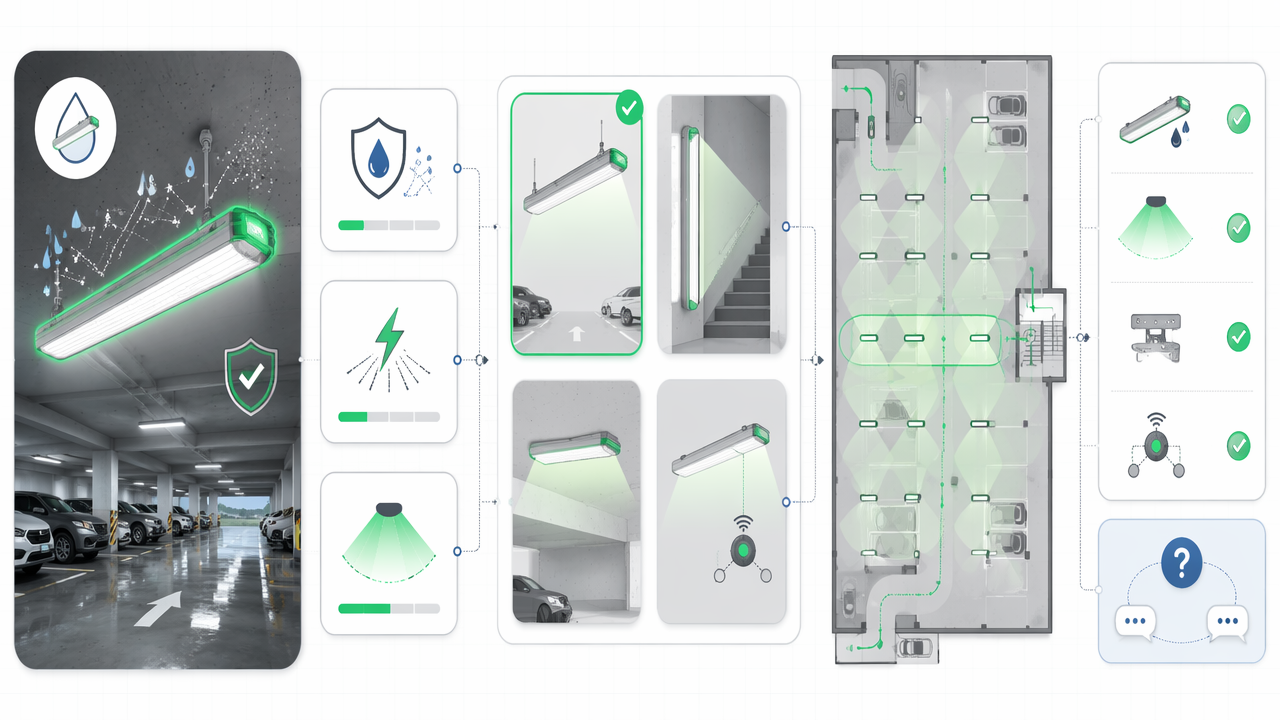
High-traffic drive aisles usually need continuous, even light that reduces contrast between parked vehicles and travel lanes. Stairwells and pedestrian paths need dependable vertical visibility. Ramps require careful glare control because drivers move between bright and dim zones quickly.
Best-use table for garage zones
| Garage area | Best vapor tight choice | Typical priority | Good spec direction |
|---|---|---|---|
| Low ceilings | 4 ft low-profile linear | Uniform light without glare | Moderate lumens, wide lens, 4000K |
| Drive aisles | Continuous linear runs | Even vehicle visibility | Higher lumen output, 120-277V, dimming |
| Ramps | Shielded or well-diffused linear | Glare control during transitions | Diffused lens, controlled spacing |
| Stairwells | Sensor-ready vapor tight | Safety and energy control | Occupancy sensor, emergency option |
| Maintenance rooms | Sealed utility fixture | Dust and moisture protection | IP65, 4000K or 5000K |
| Exposed decks | Wet-location rated fixture | Weather exposure | IP65 or higher, durable housing |
Best fit: 4-foot LED vapor tight fixtures remain the default choice for many garages because they balance coverage, installation familiarity, and replacement availability.
When 4000K or 5000K makes more sense
- 4000K: better for garages connected to retail, offices, residential buildings, or customer-facing facilities where a neutral look matters.
- 5000K: useful for industrial sites, service areas, and garages where crisp visibility is prioritized.
- Mixed CCT projects: should be planned carefully so ramps, stairwells, and drive aisles do not feel visually inconsistent.
Color temperature should also be reviewed with camera performance. Security cameras may read a space differently than the human eye, so trial installations can prevent poor image contrast.
How should contractors choose and lay out vapor tight garage lighting?
Contractors should choose and lay out vapor tight garage lighting by mapping each garage zone, setting target fixture performance, checking electrical compatibility, and confirming code-related needs before ordering materials.
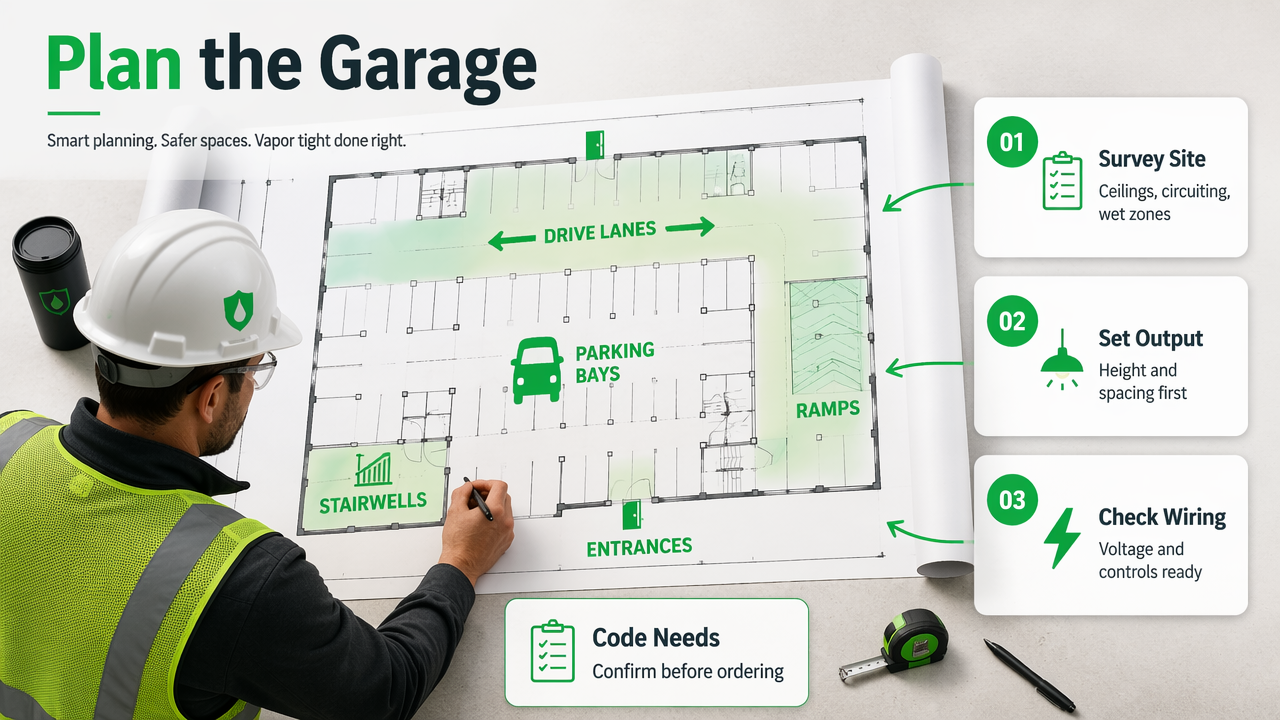
- Survey the site: document ceiling heights, bay spacing, existing circuiting, conduit paths, and wet or dusty zones.
- Group areas by use: separate drive lanes, parking bays, ramps, stairwells, entrances, and maintenance rooms.
- Select lumen packages: match output to mounting height and fixture spacing rather than copying old wattage.
- Check voltage and controls: confirm 120-277V needs, dimming type, occupancy sensors, and daylight controls.
- Plan emergency lighting: identify egress paths and fixtures that need battery backup compatibility.
- Review mounting hardware: verify surface, chain, pendant, or conduit mounting before procurement.
- Mock up a bay: test glare, shadowing, and camera visibility before a full retrofit.
The best layouts usually combine fewer fixture models with several output settings. That approach simplifies stocking, installation training, and future maintenance.
Common selection mistakes to avoid
- Choosing fixtures by wattage instead of lumen output and efficacy.
- Using open strip lights where sealed fixtures are needed.
- Ignoring lens durability in public parking areas.
- Installing one color temperature across zones without checking visual comfort.
- Skipping sensor planning until after fixtures arrive.
- Treating emergency battery backup as an afterthought.
A garage retrofit can look inexpensive on the purchase order and still cost more later if lenses yellow, clips fail, sensors do not fit, or replacement drivers are hard to source.
What to expect in 2027 garage lighting projects
Parking garage lighting in 2027 will likely favor more controls-ready vapor tight fixtures, adjustable wattage, selectable CCT, and easier integration with occupancy sensors. The direction is practical rather than flashy: owners want fewer SKUs, faster installs, lower maintenance, and lighting that supports security camera performance.
Specifiers should also expect more attention on replaceable components. Long-life LED fixtures still need serviceable drivers, lenses, clips, and sensor modules over the life of a facility.
FAQ about LED vapor tight parking garage lights
Answers to common questions about LED vapor tight parking garage lights depend on exposure level, fixture spacing, controls, and code requirements. The following short answers address the most common specification decisions for commercial properties.
Are vapor tight lights required in every parking garage?
Vapor tight lights are not automatically required in every garage, but they are often the practical choice where fixtures face moisture, dust, exhaust residue, insects, or cleaning spray. Open fixtures may be acceptable in protected interior areas, but sealed IP-rated fixtures usually reduce maintenance risk in high-traffic commercial garages.
Is IP65 enough for parking garage lighting?
IP65 is a common and useful baseline for parking garage vapor tight fixtures because it addresses dust and water-jet exposure. More demanding locations, such as exposed decks or areas with aggressive washdown practices, may justify a higher rating or a fixture specifically listed for wet locations and harsh environments.
How many lumens are needed per fixture?
The right lumen output depends on ceiling height, fixture spacing, surface reflectance, and the task area. Product examples in current search results range from 3600-lumen wraparound vapor tight fixtures to 5200-lumen commercial units, but a lighting layout should verify uniformity rather than relying on a single fixture lumen number.
Should parking garages use occupancy sensors?
Occupancy sensors are well suited for garages with variable traffic, especially stairwells, storage areas, and lower-use parking levels. Sensor-ready vapor tight fixtures can reduce unnecessary runtime while maintaining safety when people or vehicles enter the area. Controls should be specified before purchase to avoid compatibility issues.
Conclusion
The best LED vapor tight lights for parking garages are sealed IP-rated fixtures with the right lumen package, durable lenses, commercial voltage compatibility, controls readiness, and emergency lighting options where required. Strong selections start with the garage zone, not the product photo.
For a new build, retrofit, or maintenance replacement package, contractors and facility teams can compare fixture families with Jqzlighting and document wattage, lumens, CCT, mounting, sensors, and backup options before purchase. For product planning and direct sourcing, visit jqzlighting.com and request fixture guidance tied to the actual garage layout.