
TL;DR
Linear strip lights are best for utility-focused runs where high output, simple mounting, and continuous rows matter. Wraparound lights are better where glare control, finished appearance, and wider lens coverage matter, especially corridors, stairwells, retail back rooms, and offices.
Choosing between linear strip lights vs wraparound lights affects visibility, installation labor, ceiling appearance, and long-term maintenance in commercial buildings. Both fixture families are common in warehouses, workshops, garages, corridors, storage rooms, and back-of-house retail areas, but they solve different lighting problems. Jqzlighting supports commercial buyers comparing LED fixture types by application, output, mounting style, and project constraints.
Table of Contents
What are linear strip lights and wraparound lights?
Linear strip lights: long, narrow LED fixtures designed to provide a straight run of general illumination, often with exposed or slim diffused lenses.
Wraparound lights: surface-mounted linear fixtures with a lens that wraps around the sides of the housing, spreading light outward and downward.
A linear strip fixture is usually selected for practical coverage, simple rows, and high-output utility spaces. A wraparound fixture is usually selected when the space needs a cleaner finished look and softer distribution.
Key takeaway: Strip lights prioritize efficient linear coverage; wraparound lights prioritize wider diffusion and a more finished ceiling appearance.
SERP research for this topic shows 342,000 results, and the competing pages analyzed average 2,847 words. Many ranking pages are product category pages, so facility teams often need a clearer decision guide rather than another fixture catalog.
Core fixture terminology
- Housing: the metal body that holds LEDs, drivers, wiring, and mounting points.
- Lens or diffuser: the plastic or acrylic cover that softens light and protects LEDs.
- CCT: correlated color temperature, commonly selectable on modern commercial LEDs.
- Wattage selectable: a driver setting that allows output and energy use to be adjusted.
- DLC or UL options: common commercial listing and qualification signals mentioned by major product pages in this category.
How do linear strip lights vs wraparound lights compare?
Linear strip lights and wraparound lights differ most in light spread, visual finish, lens design, and best-use environment. Strip fixtures tend to look more industrial and direct; wraparound fixtures tend to look more architectural while reducing the harsh look of exposed rows.
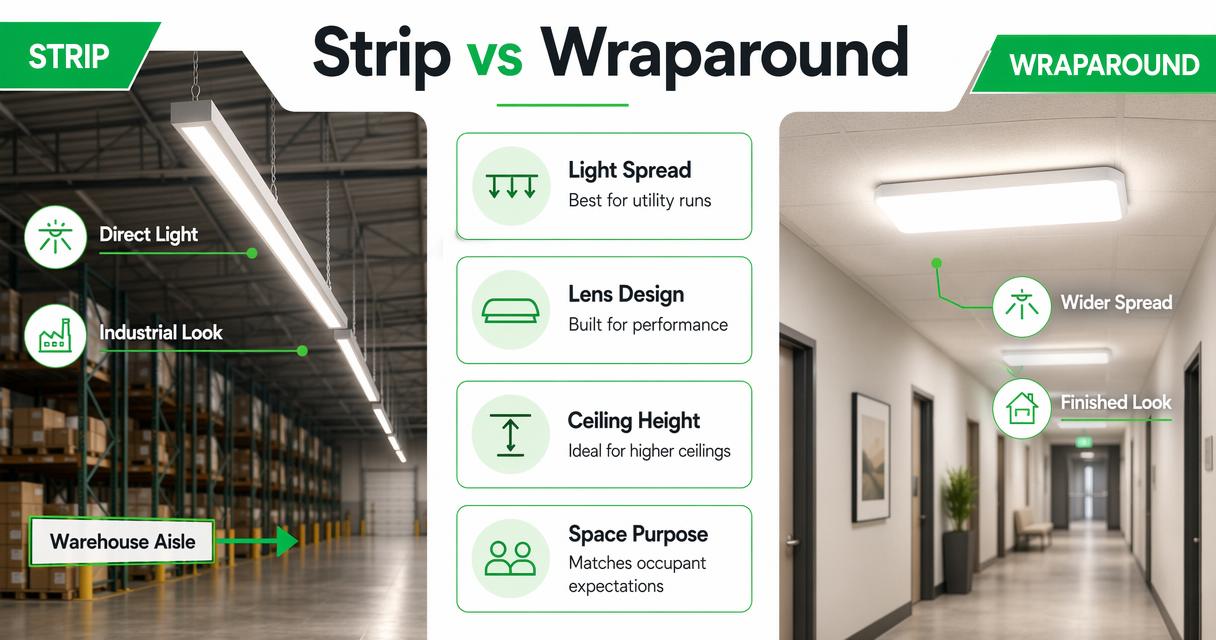
The comparison becomes clearer when fixture type is matched to space purpose, ceiling height, and occupant expectations. A warehouse aisle and a customer-adjacent corridor may need the same lumen target but not the same fixture style.
Decision table for commercial buyers
| Factor | Linear strip lights | Wraparound lights | Better fit |
|---|---|---|---|
| Light distribution | Straight, directional, row-based | Wider, softer, side-to-side diffusion | Wraparound for comfort |
| Appearance | Utility or industrial | Cleaner, finished ceiling look | Wraparound for public areas |
| Mounting | Surface, suspended, continuous rows | Mostly surface-mounted | Strip for long runs |
| Lens style | Exposed, narrow, or slim diffuser | Lens wraps around fixture sides | Wraparound for glare control |
| Output range | Often high output for work zones | Moderate to high general output | Depends on space |
| Installation speed | Fast in rows and retrofits | Fast for individual rooms | Strip for large grids |
| Maintenance access | Simple body and lens options | Lens removal may take more care | Strip for utility areas |
| Common spaces | Workshops, warehouses, storage | Corridors, stairwells, offices, retail back rooms | Application-specific |
Product listings in the current market show how wide the range can be. One ranking linear strip product page references models up to 10,160 lumens with selectable CCT and wattage, while a ranking wraparound product snippet cites an 8 ft, 110 W wraparound fixture producing 12,600 lumens. Those examples show that fixture category alone does not determine brightness; product specifications do.
Where should each fixture type be used?
Linear strip lights work best in task-heavy and utility spaces, while wraparound lights work best in occupied areas that need softer light and a cleaner appearance. The best choice depends less on the fixture name and more on the room's work pattern.
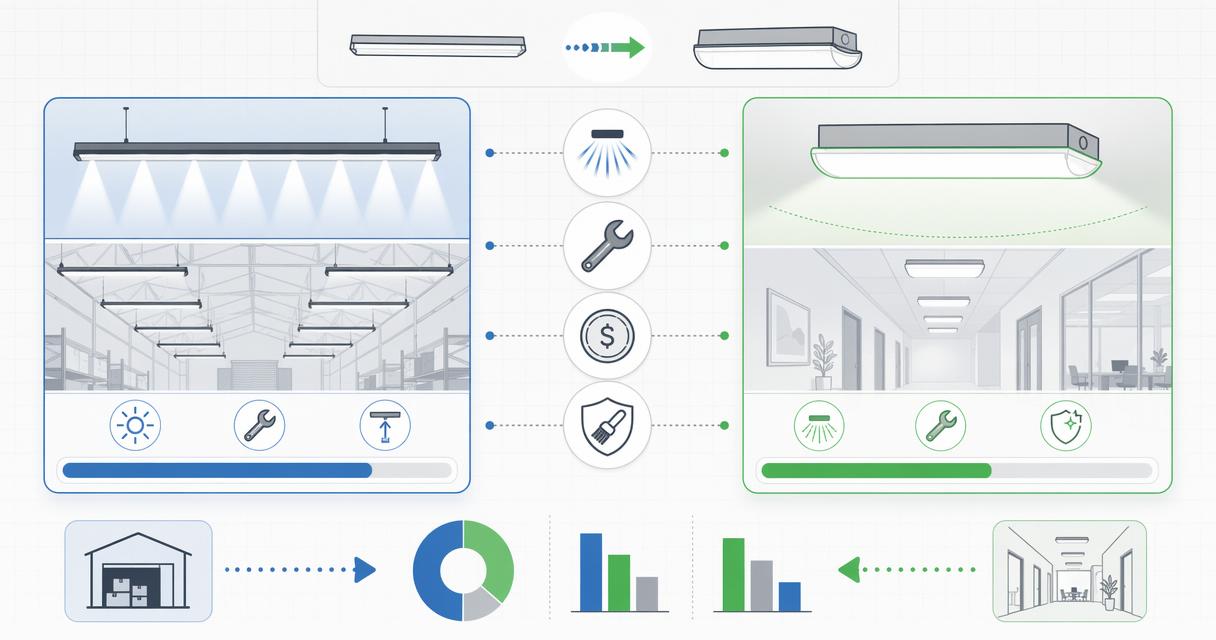
Strip fixtures are common where the ceiling is not meant to be decorative. Wraparound fixtures are common where the ceiling remains visible to staff, tenants, inspectors, or customers.
Best applications for linear strip lights
- Warehouse aisles: long rows can align with racks, benches, or circulation paths.
- Workshops: direct output supports tool benches, assembly tables, and repair bays.
- Storage rooms: simple surface mounting keeps the project practical.
- Utility rooms: exposed equipment areas rarely need decorative lenses.
- Garages and service bays: row-based placement helps reduce dark zones between vehicles.
Strip fixtures can also be suspended when ceilings are high or uneven. That flexibility makes them useful during renovations where existing junction boxes, beams, or conduit runs limit perfect fixture placement.
Best applications for wraparound lights
- Corridors: wider diffusion helps avoid the tunnel-like feel of narrow direct fixtures.
- Stairwells: a wrapped lens spreads light across steps, walls, and landings.
- Retail back rooms: staff areas often need comfort as well as output.
- Small offices: the fixture looks more finished than an exposed utility strip.
- Restrooms and service entries: surface-mounted housings fit simple commercial ceilings.
For mixed-use commercial projects, Jqzlighting can help compare fixture families by room type rather than applying one fixture everywhere. That approach supports a better balance of light quality, budget control, and visual consistency.
What affects installation, cost, and maintenance?
Installation, cost, and maintenance depend on fixture length, mounting method, driver options, lens design, and access conditions. The cheapest fixture on a product page may not be the lowest-cost choice after labor, lifts, controls, and replacements are counted.
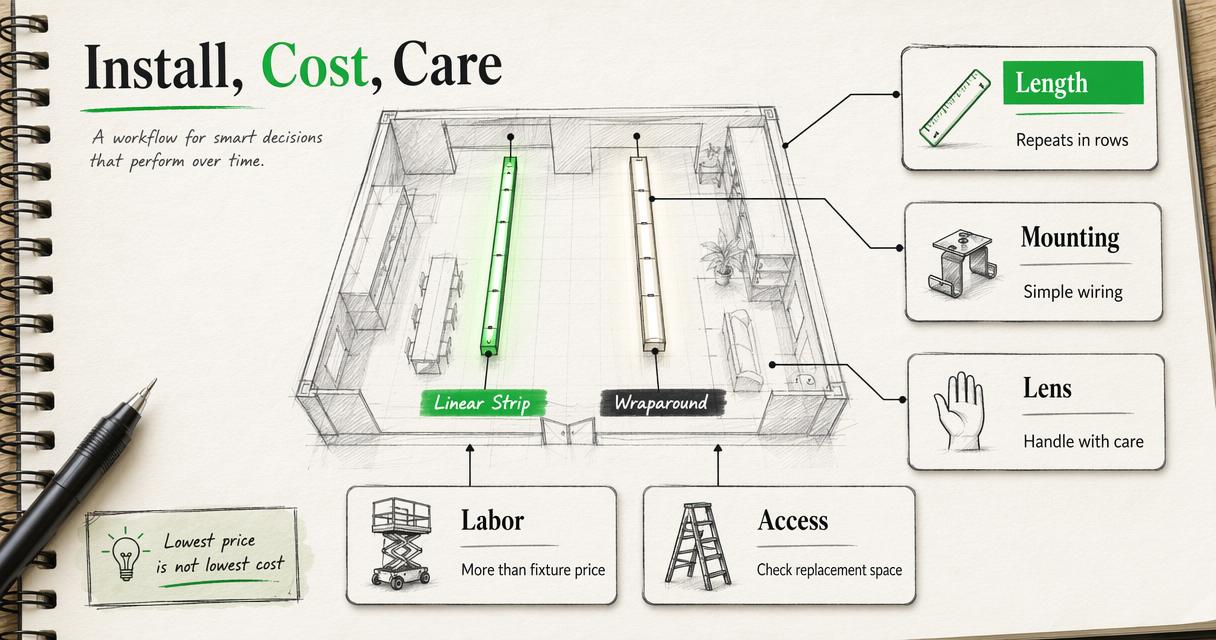
Linear strip fixtures are often efficient to install in repeated rows because layout and wiring patterns repeat. Wraparound fixtures may take slightly more care during lens handling, but they can reduce the need for extra diffusers or decorative upgrades in visible areas.
Practical selection checklist
- Confirm the room purpose: task work, storage, circulation, or customer-adjacent support space.
- Set the mounting method: surface mount, suspension, pendant hardware, or retrofit over existing boxes.
- Review output and controls: lumens, wattage selectability, CCT selectability, dimming, and sensors.
- Check lens durability: impact exposure, cleaning frequency, dust, and insect intrusion risk.
- Plan maintenance access: ladder access, lift access, lens removal, and driver replacement.
- Match appearance to occupancy: utility rooms can accept industrial fixtures; corridors may need a softer look.
Specification rule: Never choose by fixture category alone. Compare lumen output, watts, distribution, CCT, listing status, warranty terms, and mounting accessories before purchase.
Common mistakes include over-lighting small rooms, ignoring glare, mixing color temperatures across adjacent spaces, and buying fixtures without checking replacement access. In warehouses and retail service zones, those issues can create uneven lighting and unnecessary callbacks for contractors.
Frequently asked questions
Commercial lighting buyers usually ask about brightness, replacement options, and whether one fixture type can cover an entire building. The safest answer is to standardize where it makes sense, then vary fixture type where room function changes.
Are wraparound lights brighter than linear strip lights?
Wraparound lights are not automatically brighter than linear strip lights. Brightness depends on lumens, wattage, LED efficiency, lens losses, and fixture length. Current product snippets show both categories can reach high outputs, including 8 ft wraparound examples rated at 12,600 lumens and strip light examples above 10,000 lumens.
Can strip lights replace fluorescent shop lights?
LED strip fixtures are common replacements for fluorescent shop lights because they fit utility spaces, mount easily, and can be arranged in rows. The replacement still needs a layout check. Existing fluorescent spacing may not produce even LED coverage if the new beam angle, lumen package, or mounting height changes.
Do wraparound fixtures reduce glare?
Wraparound fixtures often reduce the harsh appearance of direct LEDs because the lens covers the bottom and sides of the fixture. Glare control still depends on lens material, fixture placement, mounting height, and line of sight. A clear or shallow lens may feel brighter than a deeper diffused lens.
Which fixture is better for renovations?
Linear strip lights are often better for utility-focused renovations with repeated rows, exposed ceilings, and simple wiring paths. Wraparound lights are often better where existing rooms need a more finished appearance without moving to recessed troffers or panels. Renovation teams should verify junction box locations and ceiling surface condition first.
Conclusion
The practical answer on linear strip lights vs wraparound lights is simple: choose strip lights for high-output utility runs, workshops, warehouses, storage rooms, and service areas; choose wraparound lights for corridors, stairwells, offices, retail back rooms, and other visible spaces that need softer diffusion. A mixed fixture schedule often performs better than forcing one style into every room.
For a project-specific comparison, gather ceiling heights, room dimensions, target applications, and preferred CCT before fixture selection. Contractors, facility managers, and builders can review commercial LED options with Jqzlighting, then head to jqzlighting.com for product direction that fits the actual space rather than a generic fixture label.