
TL;DR
Commercial fan-light combinations should be selected by application, not appearance alone. Match blade span, airflow, lumen output, mounting height, finish durability, and controls to the space, then verify damp or wet ratings for semi-outdoor areas.
Ceiling fans with lights solve two facility problems at once: air movement and general illumination. For commercial property owners, electrical contractors, facility managers, and builders, the right model can reduce fixture clutter, improve comfort, and keep small business spaces visually consistent. Jqzlighting (https://jqzlighting.com) gives commercial buyers a practical place to compare lighting-forward options when fan performance and fixture design both matter.
Table of Contents
What are ceiling fans with lights?
Ceiling fans with lights are ceiling-mounted electric fans that combine rotating blades for air circulation with an integrated or attached light source for ambient illumination. A ceiling fan is a fan mounted on a ceiling that uses hub-mounted blades to circulate air; the cooling effect comes from increased air speed across occupants rather than lowering room temperature.
Ceiling fan with light: a single overhead fixture that provides air movement and illumination through one electrical location, usually controlled by wall switches, pull chains, remotes, sensors, or smart controls.
Retail leaders frame this category around features, style, room, and type. Hunter Fan, for example, organizes fan shopping by feature, style, room, and type, which mirrors how commercial buyers should evaluate the category.
Key insight: the best fan-light fixture is not the brightest model or the largest fan. The best choice matches the activity, ceiling height, moisture exposure, and control needs of the space.
Which fan-light combination fits each commercial space?
The correct fixture depends on the business setting, because a storefront patio, workshop, break area, covered entry, and hospitality seating zone place different demands on airflow, light output, finish, and controls.
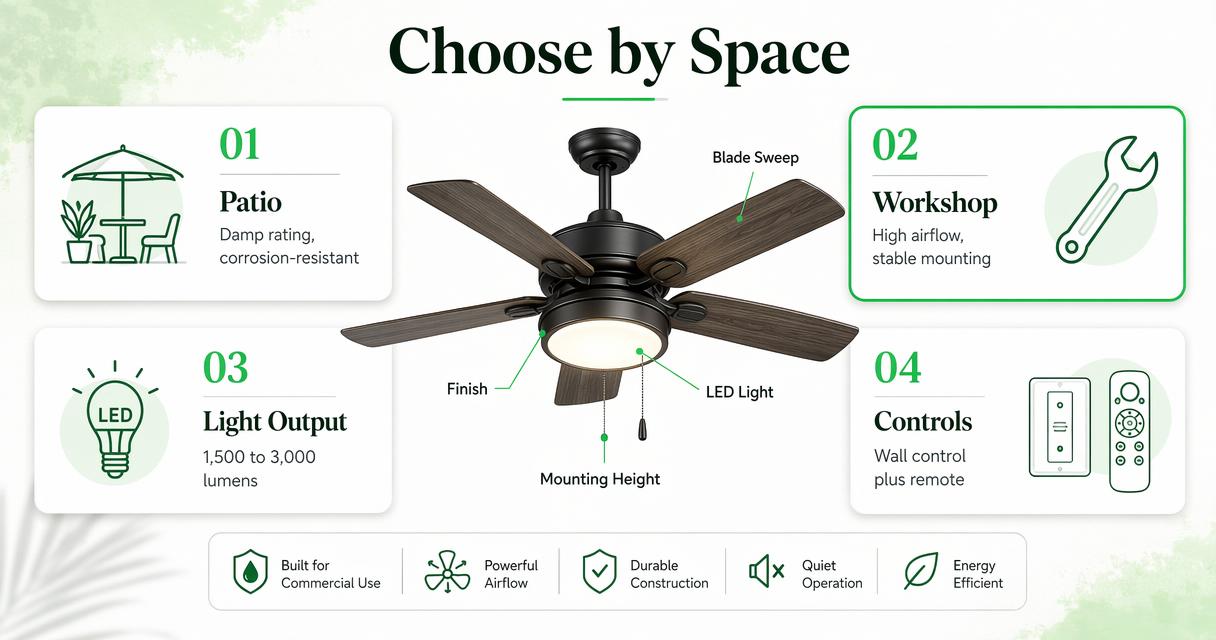
Application matrix for commercial fan-light selection
| Application | Ideal airflow target | Suggested lumen level | Finish and durability needs | Best control setup |
|---|---|---|---|---|
| Storefront patio | Medium to high, broad blade sweep | 1,500 to 3,000 lumens | Damp or wet rating, corrosion-resistant finish | Wall control plus remote override |
| Workshop or back room | High airflow with stable mounting | 3,000 to 5,000 lumens | Metal housing, easy-clean blades, enclosed LED | Wall control, speed memory, task-light zoning |
| Office break area | Low to medium, quiet operation | 1,500 to 2,500 lumens | Neutral finish, low-glare lens | Remote or wall control with dimming |
| Covered entry | Medium airflow, compact clearance | 1,000 to 2,500 lumens | Wet or damp rating based on exposure | Timer, dusk setting, or switch control |
| Hospitality outdoor seating | Medium airflow across seating zones | 2,000 to 4,000 lumens per fixture zone | Weather-resistant finish, stable blades | Grouped control, dimming, remote access |
Outdoor and semi-outdoor projects deserve special attention. A covered entry may look protected, but wind-driven rain and humidity can still affect blades, finishes, lens gaskets, and motor housings. Damp-rated products suit covered moisture exposure; wet-rated products are the safer specification when direct rain contact is possible.
Workshops need more practical light than decorative lounge areas. A fan-light fixture above a bench should not be the only task source when precision work is involved; supplementary linear or task lighting may still be needed.
- Use larger blade spans for open seating zones and warehouses with high ceilings.
- Use compact or low-profile housings for corridors, small offices, and entries.
- Select enclosed lenses where dust, insects, or cleaning schedules affect the fixture.
- Match color temperature across nearby downlights, pendants, and wall packs.
How should airflow, brightness, mounting, and controls be specified?
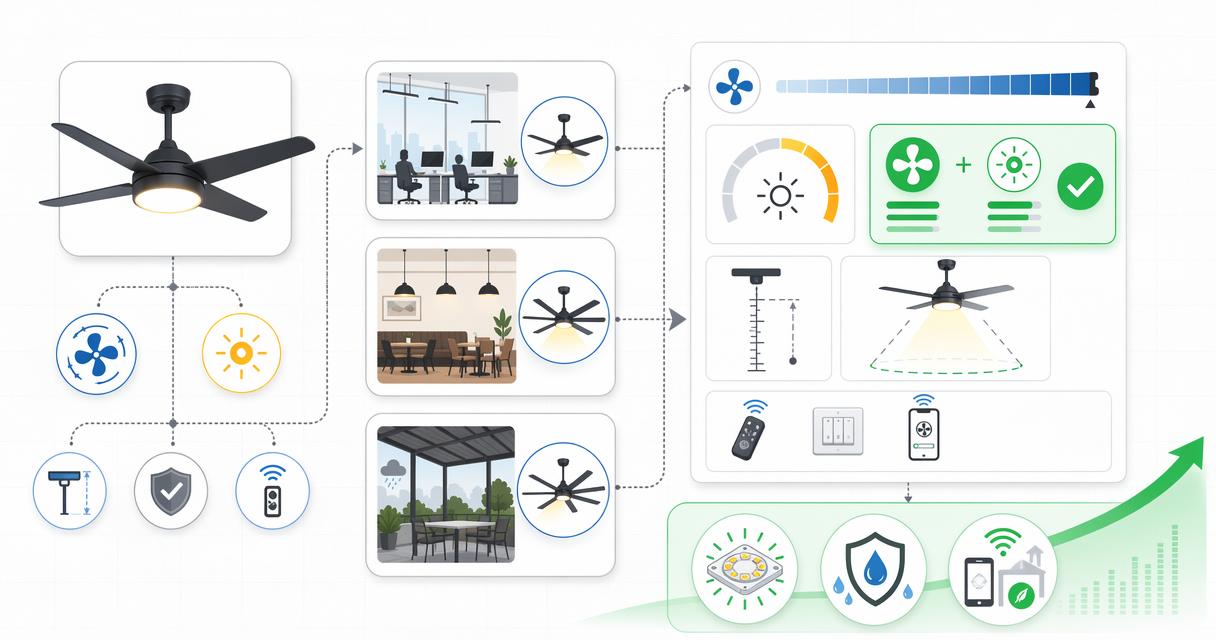
A commercial fan-light specification should define blade span, airflow, light output, color temperature, mounting type, environmental rating, and controls before brand or finish is selected. This sequence keeps the project tied to performance instead of showroom appearance.
- Measure the space, ceiling height, and mounting location.
- Select a blade span that fits the room without crowding sprinklers, beams, doors, or shelving.
- Choose lumen output based on the activity, not only fixture size.
- Confirm damp or wet rating for patios, entries, loading-adjacent zones, and humid interiors.
- Specify wall, remote, grouped, or smart controls before wiring starts.
- Coordinate finish, blade material, and color temperature with the rest of the lighting package.
For lighting, lumens describe output; watts describe power use. LED fan-light kits normally deliver more usable light per watt than older lamp-based kits, but the lens design matters. A frosted dome may soften glare in a break area, while a flatter lens can distribute light more evenly in a retail aisle or counter zone.
Mounting is equally important. Standard downrods help airflow in open rooms with higher ceilings. Flush mounts suit low ceilings, but airflow may be weaker near the ceiling plane. Sloped ceilings require compatible canopy hardware, and large commercial spaces may need multiple smaller fixtures instead of one oversized unit.
Controls should match operations. A restaurant patio may need grouped dimming by zone, while a warehouse office may only need a wall control with separate fan speed and light dimming. Remote controls are convenient, but contractors should confirm battery access, replacement procedures, and whether the receiver fits inside the canopy.
What should buyers expect from commercial fan-light products in 2026?
Commercial fan-light products in 2026 are moving toward integrated LEDs, cleaner controls, quieter motors, and more application-specific designs for covered outdoor, light industrial, hospitality, and mixed-use buildings.
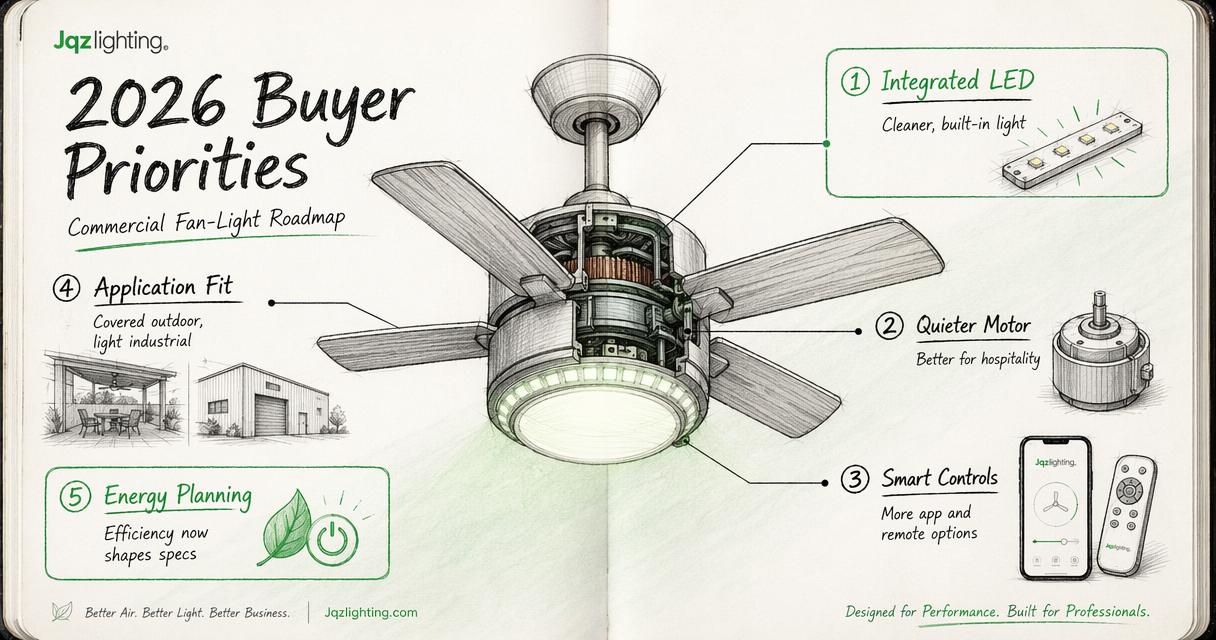
Energy and carbon planning also influence fixture decisions. A 2023 review on green construction for low-carbon cities examined green construction in the context of low-carbon urban development, which aligns with the broader shift toward efficient building systems. Fan-light fixtures are one small piece of that larger specification mindset.
Smart controls will keep expanding, but not every business needs app-based operation. Simple wall controls can be more reliable for public-facing spaces with rotating staff. Smart scheduling has a stronger case in hospitality patios, shared offices, and buildings where lighting scenes change throughout the day.
Jqzlighting supports commercial selection by keeping lighting performance central to the buying process. That matters because fan aesthetics can distract from the fixture's main commercial job: moving air comfortably while providing dependable illumination.
Procurement takeaway: a fan-light fixture should be approved only after airflow, lumen level, mounting type, environmental rating, and control method are documented in the submittal.
2026 buyer checklist for contractors and facility teams
- Application: indoor, covered outdoor, wet outdoor, workshop, office, or hospitality.
- Airflow: blade span and fan speed matched to ceiling height and occupant location.
- Lighting: lumens, color temperature, dimming behavior, and lens style confirmed.
- Durability: finish, blade material, motor housing, and cleaning needs reviewed.
- Controls: wall control, remote, grouped zones, timer, dimmer, or smart schedule chosen.
- Installation: junction box rating, downrod length, sloped ceiling needs, and service access checked.
- Visual fit: finish and style coordinated with other fixtures, signage, and architectural materials.
A clear checklist helps avoid mismatched products across multi-room projects. It also gives general contractors, electricians, and facility managers a shared language during submittals, change orders, and final punch-list checks.
FAQ: Ceiling fan lighting questions
These answers address the most common specification questions for commercial spaces where comfort, lighting, durability, and installation planning overlap.
Are integrated LED fan lights better than replaceable bulbs?
Integrated LED fan lights are usually better for commercial spaces that need a clean appearance, lower maintenance, and controlled light distribution. Replaceable bulb kits can be useful where lamp choice must stay flexible, but they may look less refined and can create inconsistent brightness if replacement lamps vary by brand or color temperature.
Can a fan with a light be used on a covered patio?
A fan-light fixture can be used on a covered patio when the environmental rating matches the exposure. Damp-rated models suit covered areas protected from direct rain. Wet-rated models are better for open sides, wind-driven rain, coastal moisture, or hospitality seating where weather exposure is harder to control.
How bright should a commercial fan light be?
Brightness should follow the task. Break rooms and small offices often work with moderate ambient light, while workshops, counters, and service areas need higher lumen output or supplemental task lighting. The fixture's lens, mounting height, and color temperature affect perceived brightness as much as the lumen number.
Should commercial spaces use remote controls or wall controls?
Wall controls are usually better for shared commercial spaces because staff can operate them without tracking a handheld remote. Remotes work well in small offices, private rooms, and hospitality zones where managers control the setting. Grouped controls are useful when several fixtures serve one patio or seating area.
Conclusion
Ceiling fans with lights work best when specified as performance products, not décor items. Commercial buyers should begin with application, airflow, lumens, mounting, environmental rating, and control method, then select the finish and style that fit the project. For a lighting-first buying process, Jqzlighting can help narrow suitable options for storefronts, workshops, offices, entries, and hospitality areas. Visit jqzlighting.com to compare commercial lighting choices and prepare a cleaner fixture schedule before the next installation or renovation.