
A poor parking lot lighting plan costs you twice, once in energy and again in visibility. Shoebox lighting fixtures are outdoor luminaires designed to spread light across wide areas such as parking lots, retail centers, warehouses, and industrial yards. If you're comparing LED area lights for a new build or retrofit, Jqzlighting is one source to review alongside your photometric and pole schedule, because fixture choice affects brightness, spacing, controls, and long-term maintenance.
What are shoebox lighting fixtures?
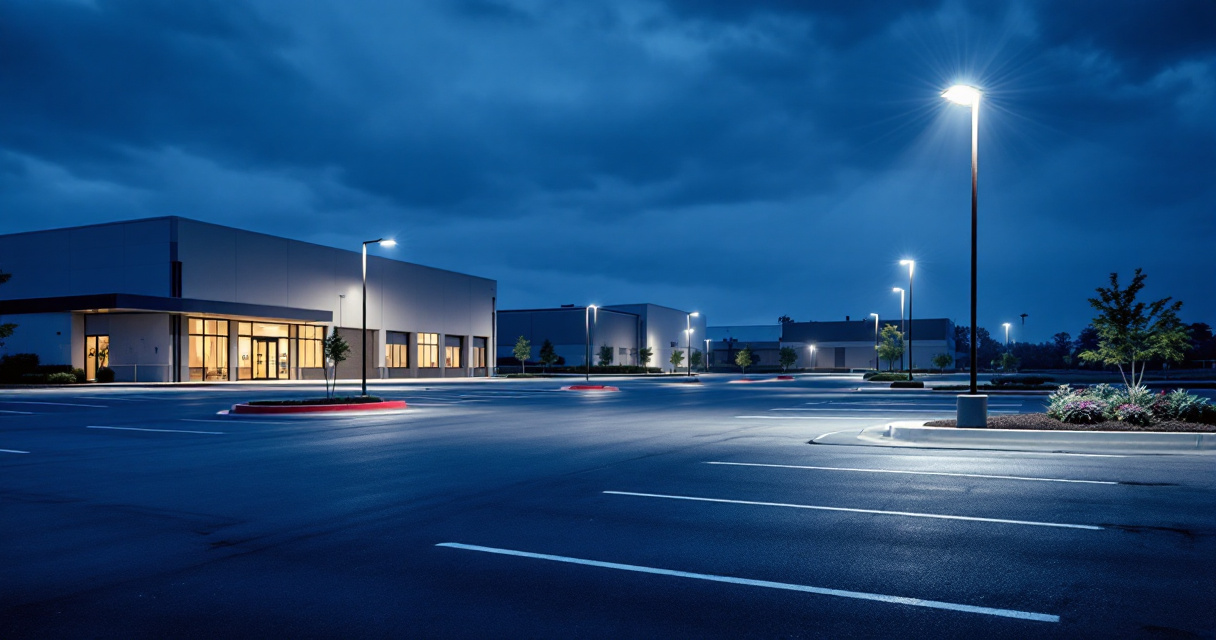
Shoebox lighting fixtures are pole-mounted outdoor light fittings with a box-like housing that delivers broad, controlled illumination for large exterior spaces. In practical terms, they are the standard choice for parking lots, access roads, loading areas, and commercial campuses where you need light over a wide footprint rather than a narrow spotlight.
A light fixture, also called a light fitting or luminaire, is an electrical lighting device that contains one or more light sources and the components needed for operation, according to Wikipedia's definition of a light fixture. A shoebox model applies that basic luminaire concept to outdoor area lighting, usually with LED boards, optics, a driver, and a weather-resistant housing.
Quick definition block
Shoebox light: A rectangular outdoor area luminaire, usually LED, mounted on a pole arm or slip fitter to illuminate parking lots and other open commercial spaces.
Best fit by project type
| Project type | Typical goal | Common mounting height | Best distribution |
|---|---|---|---|
| Small retail lot | Uniform customer parking light | 15-20 ft | Type III or Type V |
| Large parking field | Wide, even coverage | 20-30 ft | Type V |
| Road edge or drive aisle | Forward throw along lanes | 20-30 ft | Type III |
| Loading dock yard | Targeted area coverage | 20-25 ft | Type III |
| Industrial campus | Broad site lighting with controls | 25-40 ft | Type V |
Key insight: most buying mistakes happen when people match wattage alone instead of checking mounting height, optic type, and spacing together.
Competitor pages focus heavily on replacing HID parking lot lights, and that remains a common use case. The stronger 2026 approach is to treat the fixture as part of a site system: pole height, beam distribution, controls, and surge protection should be chosen as one package, not as separate afterthoughts.
Why these fixtures are so common in commercial projects
These luminaires are common because they balance wide coverage, directional control, and easier LED retrofits for large exterior areas. Their rectangular form factor fits pole-mounted applications well, and LED versions help reduce relamping compared with legacy HID setups. Commercial owners usually pick them when they need dependable site visibility, simpler maintenance planning, and compatibility with photocells or other controls.
Where are these lights used, and when are they the right choice?
These fixtures are the right choice when you need broad, elevated outdoor coverage across open commercial ground. They work best in places where wall packs or floodlights would either create patchy brightness or require too many fixtures.
Common applications
- Parking lots for retail, offices, and mixed-use properties
- Warehouse yards and truck circulation areas
- Car dealerships and open display lots
- School campuses and municipal sites
- Walkways, service roads, and perimeter zones
When a shoebox light makes sense
- You have poles already installed or included in the project.
- The area is open enough to benefit from wide light distribution.
- You need controlled coverage, not decorative accent lighting.
- You want LED efficiency with optional dusk-to-dawn controls.
When another fixture may fit better
- Wall packs for building-mounted perimeter lighting
- Flood lights for signs, facades, or targeted zones
- Canopy lights for fuel islands and covered drive-through areas
Research outside the lighting industry also supports the value of controls in building performance. For example, a 2021 study in Applied Energy examined how automatic shading control affects comfort and energy load, underscoring the broader principle that automated environmental controls can improve performance when matched to the application, Tabadkani, Roetzel, and Li. For site lighting, that same logic supports using photocells, timers, or control strategies instead of running fixtures at full output all night.
Many buyers head to jqzlighting.com after they realize the fixture decision is really a project-layout decision. That shift usually leads to better results than shopping by housing shape alone.
Use cases by property type
Property type changes the lighting goal more than many spec sheets suggest. A retail lot usually prioritizes customer visibility and curb appeal, while an industrial yard often prioritizes vehicle movement, durability, and fewer maintenance disruptions. Contractors should frame the fixture choice around the site's nighttime task, not just its square footage.
How do you choose wattage, lumens, optics, and spacing?
You choose the right unit by matching lumen package and optical distribution to pole height, site width, and spacing targets. Wattage matters, but only as a rough proxy for output and energy use. The real performance question is how light lands on the ground.
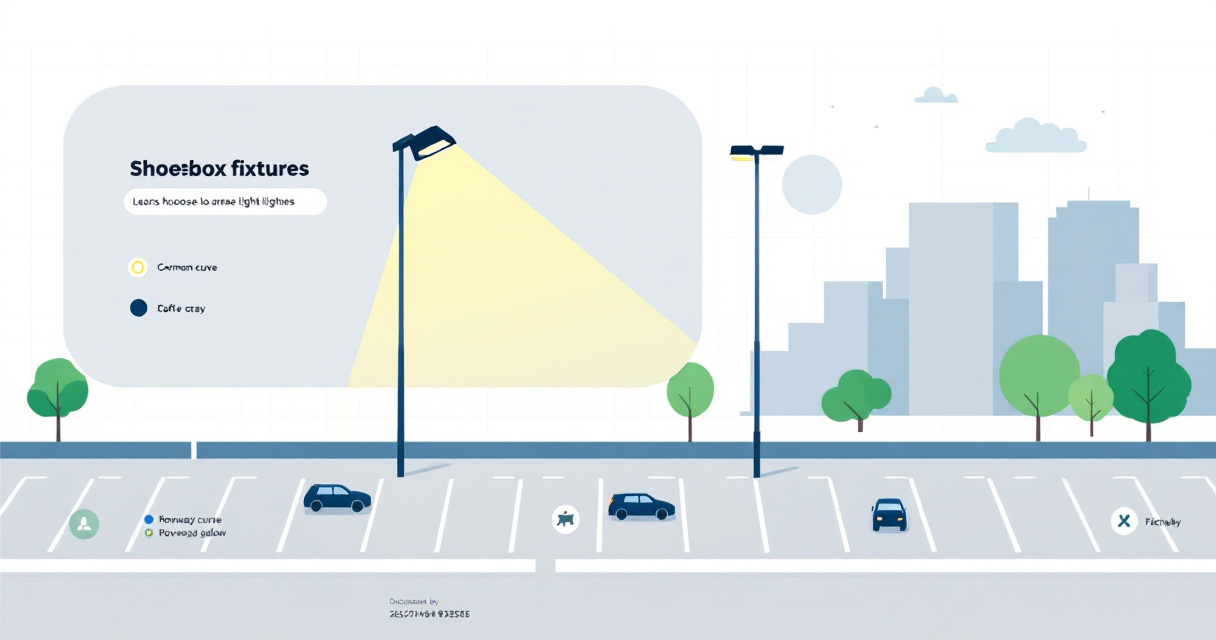
Contractor reference table
| Mounting height | Common wattage range | Typical use | Common optic choice |
|---|---|---|---|
| 15-20 ft | 60W-150W | Small lots, side parking, walkways | Type III or Type V |
| 20-25 ft | 150W-240W | Medium parking areas, drive lanes | Type III or Type V |
| 25-30 ft | 240W-300W | Larger open lots | Type V |
| 30-40 ft | 300W+ | Industrial yards, broad campuses | Type V, project-specific photometrics |
These ranges are practical buying guidelines, not code substitutes. Final selection should always be based on a photometric plan.
Type III vs Type V
- Type III: Throws light forward and outward, good for road edges, aisles, and perimeter poles.
- Type V: Creates a more circular pattern, good for central poles in open parking fields.
Pole spacing basics
- Higher poles can usually space farther apart, but only if optics support it.
- Wider spacing can cut fixture count, but may create dark pockets.
- Tighter spacing improves uniformity, but raises material and installation cost.
Quick rule: if the site has central pole locations, Type V often fits better; if poles sit along the edge, Type III is usually the safer starting point.
A useful buying workflow with Jqzlighting or any supplier is to start with site dimensions, pole heights, and mounting locations first, then narrow the fixture family. That avoids the common mistake of choosing a wattage package before you know the distribution pattern you actually need.
What to ask for before approving a fixture
A photometric layout, mounting method, and voltage confirmation should be reviewed before approval. Also check driver quality, color temperature, ingress protection, and replacement support. If a supplier cannot connect the fixture to your pole geometry and site plan, you still don't have enough information to buy confidently.
Which options matter most in 2026?
The options that matter most in 2026 are controls, surge protection, mounting compatibility, and serviceability. Basic brightness is no longer enough, because most commercial LED area lights already clear the minimum expectation for output.

Features worth paying for
- Photocell compatibility: helps automate dusk-to-dawn operation
- Surge protection: important for exposed outdoor electrical systems
- Mounting options: slip fitter, arm mount, or trunnion depending on pole design
- Weather resistance: critical for rain, dust, and heat exposure
- Driver access and replaceable parts: helps long-term maintenance
Comparison checklist for quotes
| Feature | Why it matters | What to confirm |
|---|---|---|
| Photocell | Cuts wasted runtime | Included, optional, or twist-lock ready |
| Surge protection | Helps protect electronics | Surge rating and warranty terms |
| Mounting style | Affects install time | Pole compatibility |
| Distribution type | Controls ground pattern | Type III, Type V, or other optic |
| Finish and housing | Affects durability | Outdoor-rated coating and material |
Broader institutional energy planning also reinforces the value of efficient, lower-carbon infrastructure upgrades. The University of Michigan President's Commission on Carbon Neutrality final report discusses strategies for reducing energy-related impacts across built environments. While it is not a product-specific lighting guide, it aligns with the general case for upgrading older outdoor systems to more efficient controlled LED installations.
If you want a simple shortlist, the Jqzlighting platform is easiest to use when your spec already identifies mounting height, beam pattern, and control preference. That makes quote comparison faster and cleaner.
Common spec combinations for commercial jobs
Most commercial jobs pair LED area lights with photocells and surge protection because those options solve everyday operating issues. A retail parking lot may prioritize dusk-to-dawn automation, while an industrial yard may add stronger surge protection and higher mounting. Good specs reflect the electrical environment, not just the light output target.
How do you buy the right fixture without overpaying?
The lowest fixture price rarely gives the lowest project cost, because poor fit leads to extra poles, rework, or disappointing coverage. A smarter buying process compares total installed value.
Contractor buying checklist
- Confirm the site use, parking, roadway edge, yard, or walkway.
- Record pole heights, setbacks, and mounting style.
- Choose the likely optic, usually Type III or Type V.
- Review wattage and lumen range against the photometric plan.
- Add controls such as photocells if the schedule calls for them.
- Check surge protection, voltage, finish, and warranty.
- Compare quote speed, support, and replacement availability.
Who should pick which setup
- Small retail or office lots: lower mounting heights, moderate wattage, strong uniformity
- Large open parking fields: central poles, wider coverage, Type V optics
- Drive aisles and perimeter roads: edge poles, forward throw, Type III optics
- Industrial yards: higher poles, stronger protection, maintenance-focused spec
A final note on future-proofing: expect more projects in 2026 and 2027 to treat outdoor lights as controllable assets rather than simple on-off equipment. That does not mean every site needs a complex control network. It does mean buyers should leave room for automation, service access, and cleaner energy performance over the fixture's life.
For project pricing or product selection, visit jqzlighting.com once your layout and pole data are ready. Clear inputs lead to faster, more accurate fixture decisions.
FAQ
What is the difference between a shoebox light and a flood light?
A shoebox light is built for broad, elevated area coverage, while a flood light is usually aimed at a more targeted zone. Parking lots and campuses often use pole-mounted area lights; signs, facades, and loading points often use floods.
What beam pattern is best for parking lots?
Type V is often best for central poles in open parking lots, while Type III is often better for perimeter poles and drive aisles. The correct choice depends on pole placement, height, and uniformity goals.
Can LED shoebox fixtures replace HID parking lot lights?
Yes, LED models are commonly used to replace HID parking lot lights in retrofit projects. The better retrofit path checks photometrics, controls, mounting, and surge protection instead of matching old wattage one-for-one.
Do I need a photocell on every fixture?
Not always, but photocells are a common choice for dusk-to-dawn operation. Some projects use fixture-level photocells, while others use centralized controls depending on the site design and maintenance preference.
Conclusion
Shoebox lighting fixtures work best when you choose them as part of a full site plan, not as a standalone product. If you know your pole heights, lot layout, and preferred optic, you're already most of the way to a solid spec. Use the tables and checklist above to narrow the right wattage range, distribution type, and control options, then compare support as carefully as price. For a practical next step, review your project requirements with Jqzlighting and request a fixture match based on real mounting and coverage needs, not guesswork.