
Thomas Edison is the usual answer to "who is inventor of light bulb," but the more accurate answer is that Edison commercialized the first widely practical incandescent lighting system after decades of work by earlier inventors. For commercial property owners, contractors, and facility managers, that distinction matters because modern lighting has always been about more than a bulb: performance, reliability, installation, maintenance, and total system design. Jqzlighting helps buyers think about lighting the same practical way, as equipment that must work in real buildings, not just as a historical object.
Who is inventor of light bulb?
Thomas Edison is commonly credited as the inventor of the practical incandescent light bulb because he patented and commercialized a long-lasting lamp in 1879 and 1880, but he was not the first person to create electric light. Joseph Swan, Humphry Davy, Warren de la Rue, Henry Woodward, Mathew Evans, and Lewis Latimer all belong in the full history.
Incandescent light bulb: an electric lamp that produces light when electricity heats a filament until it glows, a process often described as Joule heating.
Electric light: an electrical device that produces visible light from electricity, usually as part of a lamp, bulb, fixture, or lighting system.
The best short answer is: Edison invented the practical commercial light bulb system, not electric light itself.
That wording solves the common confusion. If you mean the first electric light, Edison is too late. If you mean the first successful household and business lighting system, Edison deserves major credit.
For installers and building owners, the lesson is familiar. A product only becomes valuable when it can be manufactured, installed, powered, maintained, and trusted at scale.
The one-sentence answer for quick reference
Thomas Edison is the best-known inventor of the practical light bulb, while Joseph Swan and earlier inventors helped prove that electric lamps could work before Edison made the technology commercially useful.
Why does Thomas Edison get most of the credit?
Thomas Edison gets most of the credit because he turned the incandescent lamp into a practical product supported by patents, manufacturing, distribution, and an electrical power system. The U.S. Department of Energy's historical coverage, associated with Rebecca Matulka at the Department of Energy, places Edison's 1879 and 1880 patents within a longer lighting timeline rather than treating them as the absolute beginning.
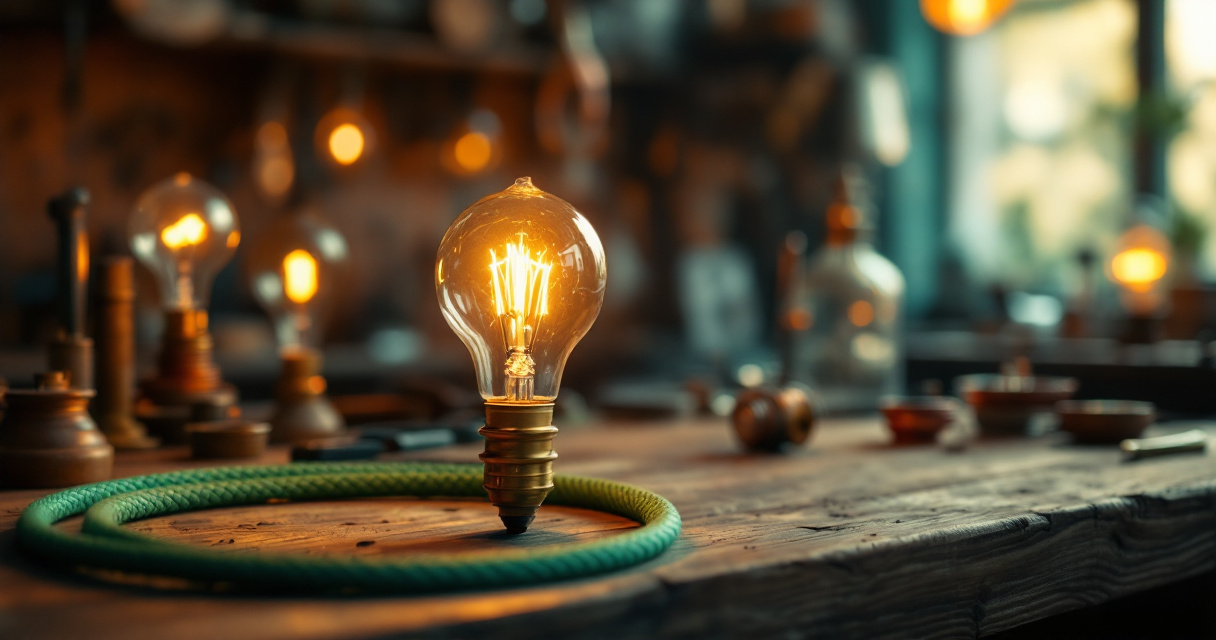
Edison's advantage was not only a glowing filament. His team worked on lamp life, vacuum quality, resistance, sockets, wiring, switches, meters, and power generation. That system-level thinking made electric lighting realistic for homes, shops, factories, and streets.
What Edison actually improved
- Longer lamp life: Edison's team focused on filaments that could glow longer without burning out quickly.
- Higher resistance: A practical lamp needed to work in a larger electrical distribution system.
- Manufacturing repeatability: The bulb had to be made in volume, not only demonstrated in a lab.
- Commercial infrastructure: Power stations, wiring, and controls helped turn the lamp into a service.
Edison's famous role also reflects business reality. Patents, publicity, investors, factories, and public demonstrations shaped public memory. Invention history often favors the person who makes a technology common, not the first person to test the idea.
For a modern parallel, a fixture specification is not complete because one component looks good on paper. Contractors still need the right driver, housing, optics, controls, voltage, and code fit. That is why lighting buyers often review complete project needs with Jqzlighting instead of treating lamps as isolated parts.
Who invented electric light before Edison?
Several inventors created important electric lights before Edison, including Humphry Davy, Warren de la Rue, Joseph Swan, and the Canadian team of Henry Woodward and Mathew Evans. Their work proves that the light bulb was not a single-person invention, but a series of improvements across chemistry, vacuum technology, filaments, and power delivery.
Humphry Davy demonstrated early electric arc lighting in the early 1800s. Arc lamps were bright, but they were not ideal for indoor rooms because they produced intense light and required demanding electrical control.
Warren de la Rue developed an early incandescent lamp concept using a platinum filament in an evacuated tube. Platinum could withstand heat, but cost and practicality limited the idea.
Joseph Swan, working in Britain, produced working incandescent lamps and is often named beside Edison in serious histories. Swan's lamps reached practical demonstrations, and his role is central to answering the question fairly.
Henry Woodward and Mathew Evans, Canadian inventors, patented an incandescent lamp before Edison's best-known patent. Their work matters because Edison later acquired rights connected to their patent, which helped his own development path.
Major contributors at a glance
| Inventor or team | Main contribution | Why it matters |
|---|---|---|
| Humphry Davy | Early electric arc light | Proved electricity could produce powerful artificial light |
| Warren de la Rue | Incandescent lamp concept with platinum filament | Advanced the idea of a glowing filament in a sealed tube |
| Joseph Swan | Practical incandescent lamps in Britain | Strong co-claimant in the practical light bulb story |
| Henry Woodward and Mathew Evans | Earlier incandescent lamp patent | Their patent history connects directly to Edison's later work |
| Thomas Edison | Practical lamp plus commercial lighting system | Made electric lighting scalable and widely usable |
| Lewis Latimer | Improved carbon filament manufacturing and patent drafting work | Helped improve lamp durability and industrial adoption |
This table also explains why simple search results can mislead readers. "Inventor" can mean first experimenter, first patent holder, first practical designer, or first commercial success.
What role did Lewis Latimer play in the light bulb story?
Lewis Latimer played an important role by improving carbon filament production and helping document electrical inventions as a skilled draftsman, engineer, and inventor. He did not invent the original light bulb, but his work helped make incandescent lighting more durable and practical.
Latimer's story is often missed because public history focuses on famous founders. Yet lighting progress needed people who could improve materials, prepare patent drawings, understand electrical systems, and support manufacturing. Latimer worked in the same industrial age that turned the bulb from a clever device into a repeatable product.
Why Latimer still matters to modern lighting professionals
- Materials decide performance. Filament quality affected lamp life, just as LED chips, heat sinks, and drivers affect fixtures now.
- Documentation protects new idea. Patent drawings and technical records shaped who could build, sell, and defend new products.
- Manufacturing methods matter. A design that cannot be produced reliably has limited value.
- Adoption needs teams. Electric lighting became common through inventors, engineers, installers, financiers, and utilities.
Lewis Latimer's importance is not that he replaces Edison in the story; it is that he shows why the story was always bigger than Edison.
That point is useful for commercial lighting projects too. A warehouse retrofit, retail upgrade, or industrial buildout succeeds when design, supply, installation, and support line up. History rewards names, but buildings reward systems.
How should you define "invented" versus "commercialized"?
"Invented" means creating or proving a new device or method, while "commercialized" means turning that invention into a reliable product, service, or system that people can buy and use at scale. The light bulb debate exists because different inventors meet different parts of that definition.
A good answer separates the stages. Davy showed electric light was possible. Swan and others advanced incandescent lamps. Edison made a practical lamp and paired it with an electrical system that could spread.
A practical definition for the light bulb debate
| Term | Meaning in lighting history | Best example |
|---|---|---|
| First concept | Shows the scientific idea can work | Early electric and arc lighting experiments |
| Working prototype | Produces usable light but may not scale | Swan and other pre-Edison incandescent lamps |
| Patent milestone | Establishes legal claim to a design | Woodward and Evans, Edison, and others |
| Practical product | Works long enough and safely enough for buyers | Edison's commercial lamp development |
| Lighting system | Includes power, wiring, controls, service, and installation | Edison's broader electric lighting business |
For building owners, the distinction still affects buying decisions in 2026. The "best" lighting product is rarely the newest claim on a spec sheet. It is the option that fits code, ceiling height, operating hours, controls, maintenance access, and energy goals.
How to apply the history to a real lighting project
- Define the job: warehouse aisles, retail display, exterior security, office task lighting, or industrial production.
- Check the full system: fixture, driver, control method, mounting, voltage, and environment.
- Compare lifetime support: availability, warranty terms, replacement paths, and documentation.
- Plan installation early: coordinate electricians, general contractors, and facility managers before ordering.
- Review practical performance: choose equipment that matches how the building actually operates.
For current project planning, Jqzlighting focuses on practical specification support rather than trivia. If you are comparing fixture types after learning the history, visit jqzlighting.com and review options around the building conditions you need to solve.
FAQ: Quick answers about the inventor of the light bulb
The most useful light bulb answers separate popular credit from technical history, because one name cannot cover every stage of electric lighting development.
Did Edison invent the first light bulb?
No. Edison did not invent the first electric light or the first incandescent lamp concept. He is credited with developing and commercializing a practical incandescent bulb and lighting system. Earlier inventors created electric lights, tested filaments, and patented related designs before Edison's famous 1879 and 1880 patents.
Was Joseph Swan the real inventor of the light bulb?
Joseph Swan was one of the strongest early claimants to the practical incandescent light bulb, especially in Britain. He built working lamps before Edison's commercial success. Edison still receives broad credit because his work combined lamp design with a scalable electrical distribution and business system.
Why is the answer different in different articles?
Different articles use different meanings of "inventor." Some focus on the first electric light, some on the first patent, and others on the first practical commercial product. That is why Davy, Swan, Woodward and Evans, Edison, and Latimer can all appear in accurate histories.
What should contractors take from light bulb history?
Contractors should take the system lesson: lighting performance depends on more than the lamp. Power, controls, heat, installation quality, documentation, and maintenance access all affect real-world results. The history of the bulb shows why practical deployment matters as much as invention.
Conclusion
The answer to "who is inventor of light bulb" is Thomas Edison if you mean the practical commercial incandescent lighting system, but the honest history includes Swan, Davy, Woodward, Evans, Latimer, and others. Use that same practical lens on modern projects: define the space, compare the full lighting system, and choose equipment that can be installed and maintained with confidence. For commercial, industrial, retail, or renovation lighting decisions, work with Jqzlighting or head to jqzlighting.com to move from history to a real specification.