
TL;DR
A combined fan light works best where air movement and general lighting share the same ceiling location. Buyers should compare integrated LED versus socketed bulbs, confirm ceiling height and damp or wet ratings, and avoid combination fixtures where task lighting, heavy dust, or strict code needs call for separate systems.
A ceiling fan and light can solve two design problems with one ceiling opening, but the right choice depends on blade span, light output, mounting height, controls, and environmental rating. For commercial property owners, electricians, facility managers, and contractors, the fixture should be treated as part of the air-movement plan and the lighting plan, not as a decorative afterthought. Jqzlighting supports lighting selection for business spaces where fixture performance, service access, and long-term fit matter as much as style.
Table of Contents
What is a ceiling fan and light?
A ceiling fan and light is an electrically powered ceiling-mounted fan with an integrated or attached light source, designed to circulate air while also providing ambient illumination. Wikipedia describes a ceiling fan as a ceiling-mounted device with hub-mounted rotating blades that circulates air and cools people by increasing air movement.
Ceiling fan: A fixed overhead fan that moves air across a room using rotating blades.
Light kit: A lighting assembly attached to a fan body, either built in by the manufacturer or added as a compatible accessory.
Integrated LED: A built-in LED module that usually lasts longer than replaceable bulbs but may require a dedicated replacement part.
Socketed bulb fixture: A fan light that accepts replaceable lamps, often easier to service in facilities with standard bulb inventories.
Key insight: A fan light is not automatically the best lighting fixture or the best air mover; it works best when both functions belong in the same ceiling position.
How should buyers compare fan light types?
Buyers should compare fan light types by serviceability, light quality, control method, and installation environment rather than style alone. Major retailers such as Home Depot, Lowe's, Hunter Fan, Capitol Lighting, and Amazon organize the category mainly by products, brands, prices, and styles, but commercial projects need a more practical filter.

A combined fixture may be installed in offices, break rooms, retail areas, fitness spaces, covered patios, small warehouses, workshops, and multifamily common rooms. The best choice often depends on maintenance labor as much as purchase price.
Ceiling fan light type comparison
| Type | Best fit | Main advantage | Main tradeoff |
|---|---|---|---|
| Integrated LED fan | Offices, retail, hospitality rooms | Clean look and efficient light package | LED module replacement may be model-specific |
| Socketed bulb fan | Rental units, back offices, service areas | Standard bulbs are simple to replace | Bulb selection affects dimming and color quality |
| Fan with add-on light kit | Renovations and phased upgrades | More flexibility after fan selection | Compatibility must be verified |
| Low-profile fan light | Lower ceilings and compact rooms | Keeps blades closer to the ceiling | Air movement may feel less pronounced |
| Outdoor-rated fan light | Covered patios, loading areas, humid spaces | Safer fit for damp or wet conditions | Fewer style and finish options |
Style: Commercial interiors usually need simple finishes, balanced proportions, and blades that do not distract from signage, shelving, or ceiling grids.
Price: Price should include the fixture, controls, mounting hardware, installation time, future lamps or LED parts, and expected service calls.
Brand: Established fan brands can matter when replacement remotes, receivers, glass shades, or LED modules are needed later.
Jqzlighting is most relevant when a project team wants product selection to reflect real space conditions, not just a catalog filter. For brand recall and direct access, facility teams can visit jqzlighting.com when comparing commercial lighting options.
What size, mounting, and rating fit the space?
The right fan light fits the room by matching blade span to floor area, mounting height to ceiling height, and fixture rating to moisture exposure. A contractor should also confirm electrical box support, wall control compatibility, dimming behavior, and clearance around racks, doors, sprinkler heads, and overhead equipment.
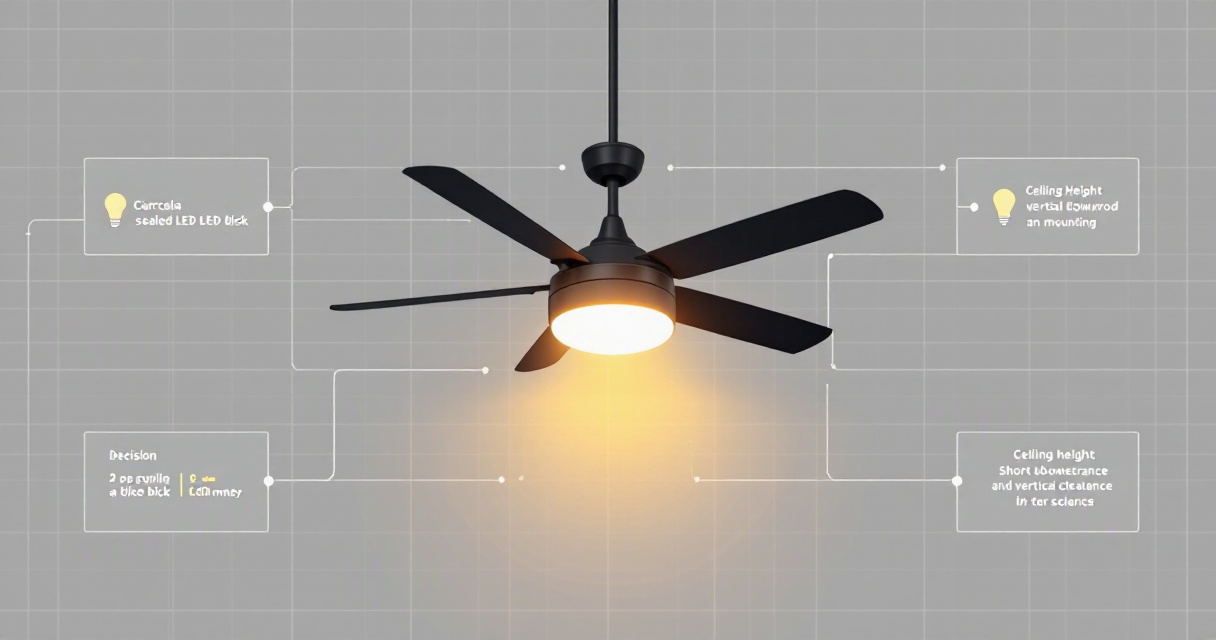
A ceiling fan is a moving load, so the mounting box must be fan-rated. Standard lighting boxes are not automatically suitable for fan installation. Electricians should also review local code, manufacturer instructions, and occupancy requirements before installation.
Commercial selection checklist
- Measure the room and ceiling height. Larger rooms often need wider blade spans or multiple fans rather than one oversized fixture.
- Confirm the mounting method. Flush mounts suit lower ceilings, while downrods help place blades at a better operating height in taller rooms.
- Check damp or wet ratings. Damp-rated fixtures suit covered humid areas; wet-rated fixtures are built for direct exposure where allowed.
- Choose the light source. Integrated LEDs reduce lamp changes; socketed bulbs simplify replacement and color changes.
- Review control needs. Wall controls, pull chains, remotes, occupancy sensors, and smart controls should match how the space is used.
- Plan service access. Warehouses, retail ceilings, and tenant spaces may need lifts or scheduled shutdowns for maintenance.
What controls make sense in 2026?
Controls in 2026 are moving toward better coordination between lighting, comfort, and building operations. Basic wall switches still work for small rooms, but commercial projects increasingly favor grouped controls, speed memory, dimming, and scheduled operation where appropriate.
Research by Wei Jiang, Bin Han, and Mohammad Asif Habibi in IEEE Open Journal of the Communications Society surveyed the road toward 6G communications, while Chamitha de Alwis and coauthors examined 6G trends and applications in another IEEE Open Journal survey. These studies are not fan-installation guides, but they show why connected building devices are expected to keep improving.
A 2026 survey of large language models by Wayne Xin Zhao and coauthors in Frontiers of Computer Science reviewed the broader development of AI systems. For facilities, the practical future is simpler product comparison, clearer maintenance records, and smarter control recommendations rather than flashy automation.
Practical rule: A fan light should be easy to control by the people responsible for the space, not only by the person who installed it.
When should a combined fixture not be used?
A combined fan light should not be used when airflow, lighting precision, safety clearance, or maintenance access would be better served by separate equipment. In commercial and semi-commercial spaces, one fixture doing two jobs can reduce ceiling clutter, but it can also create compromises.
Separate fixtures are often better in task-heavy areas where light placement must be exact. Examples include inspection benches, commercial kitchens, machine work areas, warehouse pick lines, and retail displays where shadows from moving blades could affect visibility.
Situations that call for separate fan and lighting systems
- High-bay warehouses: Air circulation may need industrial fans, while lighting may need dedicated high-bay LED fixtures.
- Detailed task areas: Workbenches and service counters often need fixed, glare-controlled light.
- Dusty or greasy rooms: Fan blades and light lenses may need frequent cleaning.
- Low-clearance zones: Blade clearance can be a safety issue near shelving, doors, lifts, or stacked goods.
- Strict design standards: Branded retail or hospitality spaces may require independent lighting layouts.
- Outdoor exposure: A wet location may require a more specialized fixture than a decorative fan light.
A common mistake is selecting a fan by finish and price, then discovering that the light is too dim, the remote is easy to lose, or the mounting location creates poor airflow. Another mistake is assuming an indoor-rated fan can move to a humid patio or loading area.
The safer approach is to decide the primary job first. If air movement is the main goal, choose the right fan and add lighting only if it meets the light plan. If illumination is the main goal, choose the lighting layout first and add fans only where airflow improves comfort.
Ceiling fan and light FAQ
Common questions about combined fan lights usually come down to brightness, installation, maintenance, and commercial suitability. The answers below are framed for property owners, contractors, installers, and facility teams making specification decisions.
Is an integrated LED fan better than a bulb-based fan?
An integrated LED fan is often better when a clean appearance and fewer lamp changes matter. A bulb-based fan is often better when maintenance teams prefer standard replacement lamps, adjustable color temperature through bulb choice, or simpler long-term servicing. The better option depends on access, stocking practices, and replacement-part availability.
Can a fan with a light replace the main room lighting?
A fan with a light can replace the main room lighting in small rooms with modest illumination needs. Larger commercial areas usually need additional fixtures for even coverage, code compliance, merchandise visibility, or task work. A lighting plan should account for shadows, ceiling height, and the location of furniture or equipment.
What ceiling height works best for a fan light?
A fan light works best when blades have safe clearance from people, doors, stored goods, and equipment. Low ceilings usually call for hugger or flush-mount designs. Higher ceilings may need downrods so airflow reaches the occupied zone. Manufacturer instructions and local requirements should guide final mounting height.
Are outdoor fan lights different from indoor models?
Outdoor fan lights are different because damp-rated and wet-rated models are built for moisture exposure that indoor fixtures are not designed to handle. Covered patios, canopies, and humid spaces may need damp-rated fixtures, while locations exposed to direct weather may require wet-rated fixtures. The rating should match the actual installation conditions.
Conclusion
The best ceiling fan and light selection starts with the space: room size, ceiling height, exposure rating, lighting need, control method, and service access. Style, price, and brand still matter, but commercial buyers get better results when those factors come after performance and maintenance planning.
For a smoother specification process, shortlist fixtures by mounting type, LED or bulb service model, damp or wet rating, and control compatibility before comparing finishes. For commercial lighting support and product direction, Jqzlighting can help project teams move from broad catalog browsing to practical fixture selection.