Lighting maintenance quietly drains thousands of dollars from commercial facilities every year. Burned‑out bulbs, lift rentals, labor hours, and operational disruptions all add up. Modern LED technology changes that equation. Because LEDs last dramatically longer and operate more efficiently than traditional lamps, businesses can reduce replacement cycles, minimize maintenance labor, and improve uptime across warehouses, offices, and retail environments. For contractors and facility managers tracking operating expenses, understanding these maintenance savings is often the key factor that justifies a lighting upgrade. Resources like The JQZ Lighting Journal help businesses evaluate these long‑term benefits while choosing commercial‑grade fixtures built for demanding environments.
Why Maintenance Costs Are a Major Expense in Commercial Lighting
Lighting maintenance involves more than replacing a lamp. In commercial environments such as warehouses, factories, or parking facilities, every replacement requires labor, equipment, and sometimes operational downtime. Over years of operation, these costs often exceed the original fixture price.
Traditional lighting technologies such as fluorescent tubes, metal halide lamps, and high‑pressure sodium fixtures typically require frequent replacement. Many commercial lamps operate for thousands of hours, but facilities running lights 10–16 hours daily can still face regular maintenance cycles.
A light‑emitting diode (LED) is a semiconductor device that emits light when electric current flows through it, converting electrical energy directly into visible light. Because this process is far more efficient than filament or gas‑based lighting, LED lamps waste less energy and generate less heat. According to the Wikipedia definition of an LED lamp, these lights are significantly more energy‑efficient than incandescent or fluorescent equivalents.
Hidden Maintenance Costs That Add Up
Several operational expenses make traditional lighting costly over time:
- Labor for replacements, often requiring electricians or maintenance teams
- Lift or ladder equipment for high ceilings in warehouses or factories
- Inventory management for spare lamps and ballasts
- Operational disruption during maintenance activities
- Ballast or driver failures in older lighting systems
In large facilities, maintenance labor and equipment access often cost more than the replacement lamps themselves.
Typical Maintenance Tasks by Lighting Type
| Lighting Type | Common Maintenance | Frequency in Commercial Use |
|---|---|---|
| Fluorescent tubes | Tube replacement, ballast changes | Moderate |
| Metal halide | Lamp replacement, color degradation | Frequent |
| High-pressure sodium | Bulb replacement, lumen drop | Frequent |
| LED fixtures | Occasional driver checks | Rare |
Facilities that run lighting continuously, such as logistics centers or manufacturing plants, experience the highest maintenance burden with traditional lighting systems.
How LED Fixtures Reduce Replacement Frequency
The biggest maintenance advantage of commercial LEDs is lifespan. LEDs operate far longer than most legacy lighting technologies because they rely on solid‑state electronics instead of filaments or gas discharge processes.
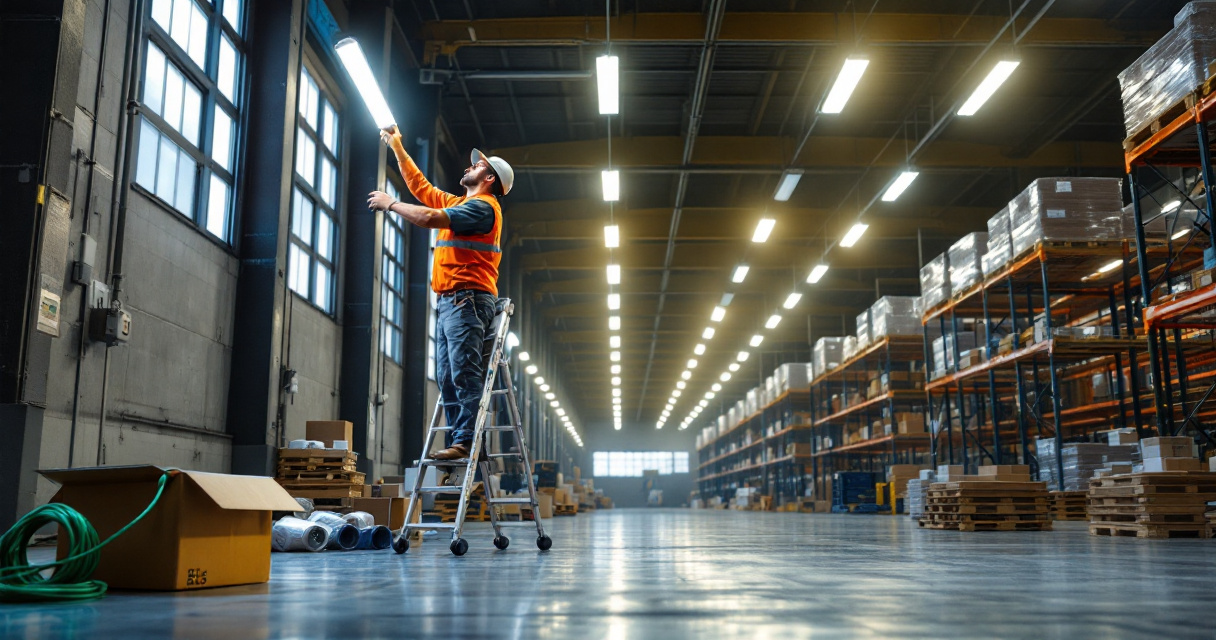
Many commercial LED fixtures are rated for tens of thousands of operating hours. For facilities running lights 12 hours per day, that can translate into many years of use before noticeable performance decline.
Longer Lifespan Means Fewer Maintenance Cycles
Traditional lamps degrade quickly, especially when frequently switched on and off. LEDs are far less sensitive to switching cycles and temperature fluctuations, which improves reliability in commercial environments.
Key lifespan advantages include:
- Solid-state design reduces mechanical failure
- Lower heat output protects internal components
- No fragile filaments or glass tubes
- Stable light output over time
For property owners managing hundreds or thousands of fixtures, reducing even one maintenance cycle per year can deliver significant cost savings.
Example Replacement Cycle Comparison
| Lighting System | Typical Operational Lifespan | Replacement Impact |
|---|---|---|
| Fluorescent tube | Shorter service life | Regular replacements required |
| Metal halide lamp | Degrades quickly | Scheduled replacement cycles |
| Commercial LED fixture | Extended operating life | Minimal replacements |
These durability advantages explain why contractors increasingly recommend LED upgrades for warehouses, parking lots, and large retail buildings.
Facility managers looking for fixture comparisons and installation guidance often review technical insights published on The JQZ Lighting Journal, which focuses on commercial‑grade LED systems designed for long service life.
Labor, Equipment, and Downtime Savings for Large Facilities
Maintenance labor is often the largest hidden expense in lighting operations. Replacing fixtures in high‑ceiling buildings or outdoor areas requires specialized equipment and trained personnel.
LED lighting dramatically reduces these service visits.
Reduced Labor Requirements
When fixtures last longer, maintenance teams spend less time replacing lamps or diagnosing failures. This matters most in facilities where lighting systems include hundreds of fixtures.
Typical labor savings come from:
- Fewer service calls
- Reduced electrician hours
- Less time coordinating shutdowns
- Lower lift equipment rentals
For example, replacing a lamp in a 30‑foot warehouse ceiling may require a scissor lift and safety crew. Avoiding those replacements for years at a time lowers operating expenses significantly.
Operational Downtime and Safety Improvements
Maintenance activity often interrupts normal operations. In logistics warehouses or retail environments, shutting down aisles or production areas creates real business costs.
LED systems reduce this disruption in several ways:
- Fewer burned‑out lamps, which prevents dark areas in workspaces.
- More reliable illumination, improving safety and visibility.
- Less maintenance scheduling, keeping operations running normally.
Reduced maintenance visits mean fewer safety risks associated with lifts, ladders, and electrical work.
Many facility managers rely on planning resources available through The JQZ Lighting Journal platform to determine the most reliable fixtures for high‑traffic commercial environments.
Additional Cost Savings: Energy, Rebates, and Sustainability
Maintenance savings are only part of the financial case for LEDs. Energy efficiency, rebates, and environmental goals also contribute to the return on investment.
Energy Efficiency Reduces Overall Operating Costs
LEDs convert electricity into light far more efficiently than older lighting technologies. Lower energy consumption directly reduces monthly electricity bills, especially in facilities where lighting runs for long hours.
Rebates and Incentive Programs
Many utilities and regional energy programs offer incentives for installing efficient lighting. These programs often apply to DLC‑listed commercial LED fixtures used in warehouses, offices, and parking facilities.
Typical incentive benefits include:
- Reduced upfront project cost
- Faster payback periods
- Improved ROI for retrofit projects
Sustainability and Carbon Reduction
Energy efficiency improvements also support sustainability targets. Research examining the transition to low‑carbon energy systems highlights the importance of improving efficiency across infrastructure sectors, including electricity use in buildings. A 2022 study published in Frontiers in Energy Research examined pathways for low‑carbon electricity systems and noted that efficiency improvements are a key part of reducing emissions in energy consumption (Frontiers in Energy Research).
LED lighting contributes to these goals by reducing electricity demand while producing the same or higher quality illumination.
For companies tracking environmental metrics, lighting upgrades often deliver one of the fastest reductions in building energy use.
What to Expect from Commercial LED Lighting Maintenance in the Next Few Years
LED technology continues to improve, and maintenance requirements are expected to drop even further as fixture designs evolve.
Smart Lighting Diagnostics
Many modern commercial fixtures now integrate sensors and controls. These systems allow facility managers to monitor performance remotely and identify issues before failures occur.
Examples of emerging features include:
- Remote monitoring of fixture performance
- Automated alerts for driver or circuit issues
- Integration with building management systems
Modular Fixture Design
Manufacturers increasingly design fixtures with replaceable drivers and modular components. This approach simplifies repairs and extends fixture lifespan without replacing the entire unit.
Higher Reliability Components
New LED drivers, thermal management systems, and optical materials continue improving durability in commercial environments.
Facility planners and contractors researching these developments often consult The JQZ Lighting Journal, which publishes practical insights on fixture performance, installation strategies, and wholesale lighting solutions for commercial buildings.
The future of commercial lighting maintenance is not just fewer replacements, but smarter systems that prevent failures altogether.
Conclusion
Maintenance savings often make the strongest financial argument for upgrading to LED lighting. Longer fixture lifespan, fewer replacements, reduced labor, and minimal operational disruptions combine to lower total lighting costs for warehouses, retail facilities, offices, and industrial buildings.
When evaluating a lighting upgrade, look beyond the purchase price. Consider the full lifecycle cost, including maintenance labor, downtime, and equipment access. Modern commercial LED fixtures are designed to operate reliably for years with minimal intervention.
For facility managers, contractors, and property owners planning lighting upgrades, The JQZ Lighting Journal provides practical guidance on commercial LED products, installation strategies, and long‑term cost savings. Exploring those resources can help you choose the right fixtures and maximize maintenance savings across your entire building.