A led drop ceiling lights retrofit from fluorescent is usually the fastest way to modernize an office, retail floor, classroom, or warehouse without rebuilding the ceiling grid. A fluorescent lamp is a low-pressure mercury-vapor gas-discharge lamp that uses fluorescence to produce visible light, while a dropped ceiling is a secondary ceiling hung below the structural ceiling, often called a suspended or T-bar ceiling. That matters because most retrofit projects happen inside existing troffers already sitting in that grid. If you want practical lighting guidance for commercial spaces, start with The JQZ Lighting Journal.
What a fluorescent-to-LED troffer retrofit actually changes
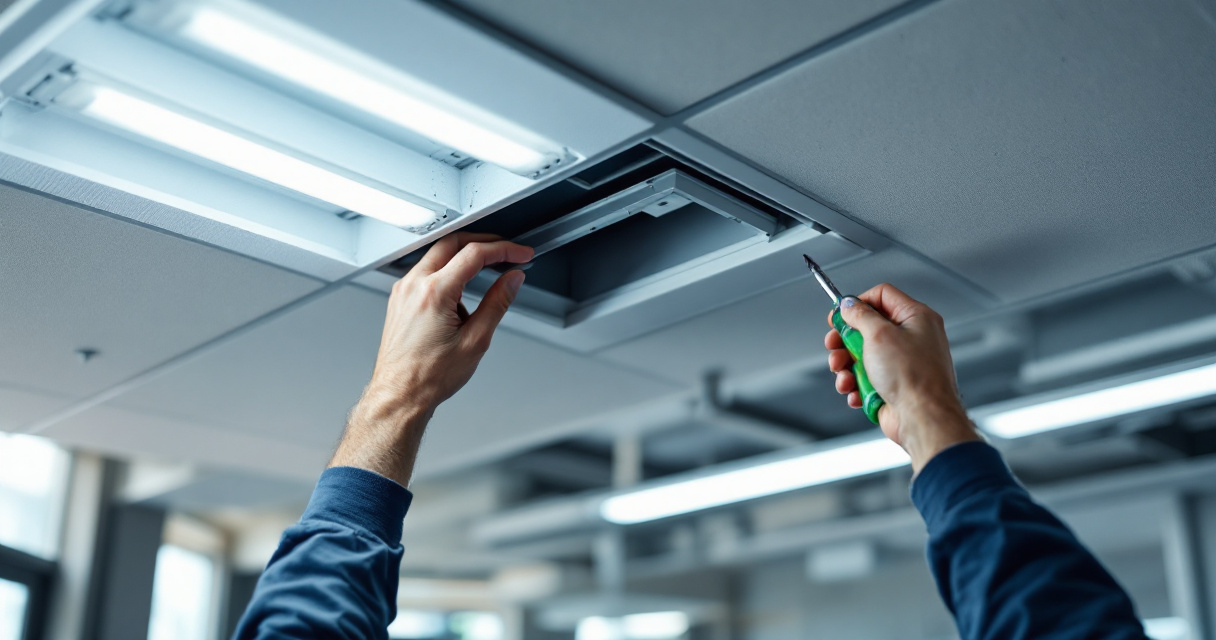
A fluorescent-to-LED retrofit changes the light source, and often the wiring path, while keeping some or all of the existing ceiling-mounted fixture shell. In practice, you are upgrading the troffer inside the drop ceiling, not replacing the whole suspended ceiling system.
Key retrofit terms you should know
- Troffer: a rectangular light fixture that fits into a drop ceiling grid.
- Retrofit kit: an LED package designed to reuse the existing fixture housing.
- Tube replacement: LED tubes installed into an existing fluorescent fixture, sometimes with ballast compatibility and sometimes with ballast bypass.
- Full fixture replacement: removing the old troffer and installing a new LED panel or troffer.
A retrofit can be attractive when the fixture housing is still sound, the ceiling grid is in good shape, and you want less disruption during occupied hours. Competitor pages focus heavily on product listings, but the real decision is about labor, future maintenance, and lighting quality.
A good retrofit keeps the ceiling intact, improves performance, and avoids locking you into hard-to-source fluorescent parts.
Research outside the lighting niche also supports the broader efficiency case. A 2021 review in Applied Engineering in Agriculture discusses electricity conservation as a major operating concern in facilities, which is why lighting upgrades remain a common first step in older buildings Mohsenimanesh et al., 2021. For owners comparing building upgrades, related planning advice on commercial LED lighting upgrades can help frame scope and budget even before fixture selection.
The three retrofit paths for drop ceiling fixtures
The best retrofit path depends on fixture condition, labor access, and how long you plan to keep the space. Most projects fall into one of three categories.
Compare retrofit kits, LED tubes, and full replacement
A side-by-side comparison makes the tradeoffs clearer than generic product pages.
Retrofit option comparison table
| Option | What stays in place | Best use case | Main advantage | Main limitation |
|---|---|---|---|---|
| LED retrofit kit | Existing troffer housing | Sound fixture body, fast modernization | Fresh LED light engine without full tear-out | Installation complexity varies by kit |
| LED tube conversion | Most existing fixture components | Lowest upfront fixture change | Quick path for large counts of troffers | Future maintenance depends on wiring and compatibility choice |
| New LED troffer or panel | Ceiling grid, not the old fixture | Damaged housings or premium finish goals | Cleanest long-term reset | More material and labor than simple retrofits |
Tube conversions are often chosen for speed, but they are not always the cleanest long-term answer. Retrofit kits can offer a better optical result because they replace more of the old fluorescent internals. Full replacement usually wins when housings are rusted, bent, or visually dated.
Who should pick which
- Pick LED tubes if you need a fast, budget-controlled upgrade across many similar fixtures.
- Pick retrofit kits if you want better appearance and a more complete internal refresh while keeping the ceiling opening.
- Pick new fixtures if existing troffers are damaged, stained, or mismatched after years of patchwork repairs.
If you're comparing approaches across occupied buildings, The JQZ Lighting Journal often covers these practical tradeoffs in a more decision-focused way than typical ecommerce pages. You can also review broader project planning ideas through this guide to warehouse lighting layout and fixture choices.
How to plan a safe, code-aware retrofit before any fixtures come down
The smartest retrofit starts with an audit of fixture type, ballast condition, branch circuit layout, and light-level goals. This is where many projects either save money or create avoidable callbacks.
Pre-install checklist for contractors and facility teams
A short checklist keeps crews aligned before ordering product.
- Count fixture sizes, usually 2x2 or 2x4 troffers.
- Identify whether existing lamps are T8, T12, or another fluorescent type.
- Record ballast make, age, and condition.
- Check whether emergency lighting circuits feed any fixtures.
- Confirm color temperature target, such as matching office or retail standards.
- Note ceiling grid condition and any damaged tiles.
- Decide if controls, occupancy sensors, or daylight response will be added.
Lighting should not be planned in isolation from the space. A 2022 Energy and Buildings study on integrated daylighting and electric lighting design looked at lessons from international case studies, reinforcing that electric light quality and daylight strategy work best when considered together Gentile, Lee, and Osterhaus, 2022.
Common retrofit mistakes to avoid
- Ordering lamps or kits before confirming ballast type.
- Mixing color temperatures in the same room.
- Ignoring lens yellowing or reflector damage in old troffers.
- Treating emergency fixtures like standard branch fixtures.
- Upgrading wattage without checking actual task lighting needs.
If the housing, reflector, and wiring condition are poor, replacement often beats retrofitting, even when the first cost looks higher.
Thermal conditions matter too. A 2022 modern review tied building resilience to cooling performance, which matters because more efficient lighting generally reduces internal heat gains compared with older systems Ai Zhengtao, Akander, and Arens, 2022. That won't solve cooling problems alone, but it can support broader building-efficiency goals.
How led drop ceiling lights retrofit from fluorescent pays off in operations
A well-planned LED upgrade usually pays off through lower maintenance, more consistent light, and easier standardization across rooms. Owners often focus on energy first, but operations teams usually feel the maintenance benefit just as quickly.

Operational benefits that matter in real buildings
Fluorescent systems age in messy ways. Lamps darken at the ends, ballasts fail at different times, and fixture appearance becomes inconsistent across a floor.
LED retrofits can help by:
- Reducing relamping cycles in offices, retail stores, schools, and back-of-house spaces
- Improving startup behavior compared with aging fluorescent systems
- Making color consistency easier across large fixture counts
- Supporting cleaner visual appearance when old lenses and lamp shadows are removed
This is especially useful in spaces where uptime matters, such as logistics rooms, sales floors, and tenant corridors. For adjacent exterior and security planning, facility teams often pair interior upgrades with commercial flood lighting strategies.
When replacement is the smarter financial choice
Retrofit is not automatically the cheapest whole-life decision. If you are already paying for ceiling tile repair, repainting, or electrical rework, replacing the full fixture may create a cleaner asset with fewer unknowns.
Choose replacement over retrofit when:
- Housings show corrosion or physical damage.
- Troffers have inconsistent sizes or nonstandard legacy parts.
- You want a different visual style, such as flatter LED panels.
- The building is being repositioned for new tenants.
For many owners, the winning move is not "retrofit everything" but "retrofit where the shell is good, replace where it is not." That mixed approach is often the most practical one in 2026.
What to ask suppliers and installers in 2026 before you approve the project
The right supplier conversation should cover compatibility, serviceability, light quality, and installation method, not just wattage and price. That is where better projects separate themselves from bargain-bin upgrades.
Questions that prevent expensive rework
Use these questions during quoting and submittals:
- Is the product a retrofit kit, a tube conversion, or a full fixture?
- Does installation keep or bypass the ballast?
- What ceiling opening and fixture dimensions does it fit?
- How will emergency circuits be handled?
- What color temperature and distribution are available?
- Will the finished fixture look uniform across old and new rooms?
A lot of online results still blur the line between tube swaps and true troffer retrofit kits. That creates confusion for buyers who think they are getting a full modernization when they are really buying only lamps.
How The JQZ Lighting Journal handles this topic
The JQZ Lighting Journal is most useful when you need practical commercial guidance rather than a generic product pitch. It helps readers compare retrofit paths, understand where full replacement makes more sense, and plan lighting choices around the actual building. For teams gathering specs and next-step ideas, more project guidance is available on jqzlighting.com.
If you want a simple approval path, ask your contractor for a room-by-room schedule showing fixture condition, selected retrofit type, color temperature, and any exceptions. That document catches mismatches before procurement starts.
Conclusion
A led drop ceiling lights retrofit from fluorescent makes sense when your troffer housings are still solid, your ceiling grid is staying put, and you want a faster upgrade with less disruption than full replacement. Start with a fixture audit, compare kits against tube conversions and new fixtures, and push suppliers to document wiring method, compatibility, and visual results room by room. If you're planning a commercial lighting upgrade now, use The JQZ Lighting Journal as your starting point, then head to jqzlighting.com for more project-focused guidance and product direction before you order.