A poorly lit walkway is one of the most common safety risks around commercial buildings. Property managers often discover that dim paths, uneven lighting, or outdated fixtures lead to complaints, security concerns, and higher maintenance costs. Modern LED lighting solves these problems with efficient, durable fixtures that illuminate walkways consistently while using far less power than older technologies. According to Wikipedia, an LED lamp produces light using light‑emitting diodes and is significantly more energy‑efficient than incandescent or fluorescent lamps. For facility managers and contractors, this means better visibility, longer fixture life, and lower operating costs. Resources such as The JQZ Lighting Journal regularly highlight commercial-grade LED solutions that help businesses upgrade outdoor paths, sidewalks, and landscaped walkways without increasing energy budgets.
Why LED Walkway Lighting Matters for Safety and Visibility
Outdoor walkways guide visitors through parking areas, campuses, retail entrances, and landscaped spaces. Without proper lighting, these areas quickly become safety hazards. LED fixtures solve this by delivering consistent brightness while reducing dark spots along paths.
Research on walkability published in Frontiers in Built Environment found that features of the physical environment, including lighting quality, strongly influence pedestrian safety and usability of public spaces. The study examined how environmental design factors shape walkability and overall livability of built environments. Good lighting allows pedestrians to navigate surfaces clearly and improves perceived safety after dark. See the research: Walkability and Its Relationships With Health, Sustainability, and Livability.
Well‑lit pedestrian paths improve both safety perception and actual usability of outdoor spaces.
LED fixtures are particularly effective for walkways because they produce focused illumination without excessive glare. Their directional output makes it easier to highlight edges, steps, and space features.
Key Safety Benefits of LED Path Lighting
- Improved visibility: LEDs create bright, uniform light that reveals uneven surfaces, obstacles, and changes in elevation.
- Better color rendering: Objects and path edges appear clearer compared with older sodium lamps.
- Lower maintenance risks: Long lifespans reduce the need for frequent ladder work or service calls.
- Instant brightness: LEDs reach full output immediately, which is useful for motion‑sensor controlled areas.
Commercial properties such as warehouses, retail complexes, and campuses rely on these features to keep pedestrian routes safe during evening hours.
Types of LED Fixtures Used for Outdoor Pathways
Not every pathway requires the same lighting solution. Designers often combine several fixture types to create even coverage without excessive brightness.
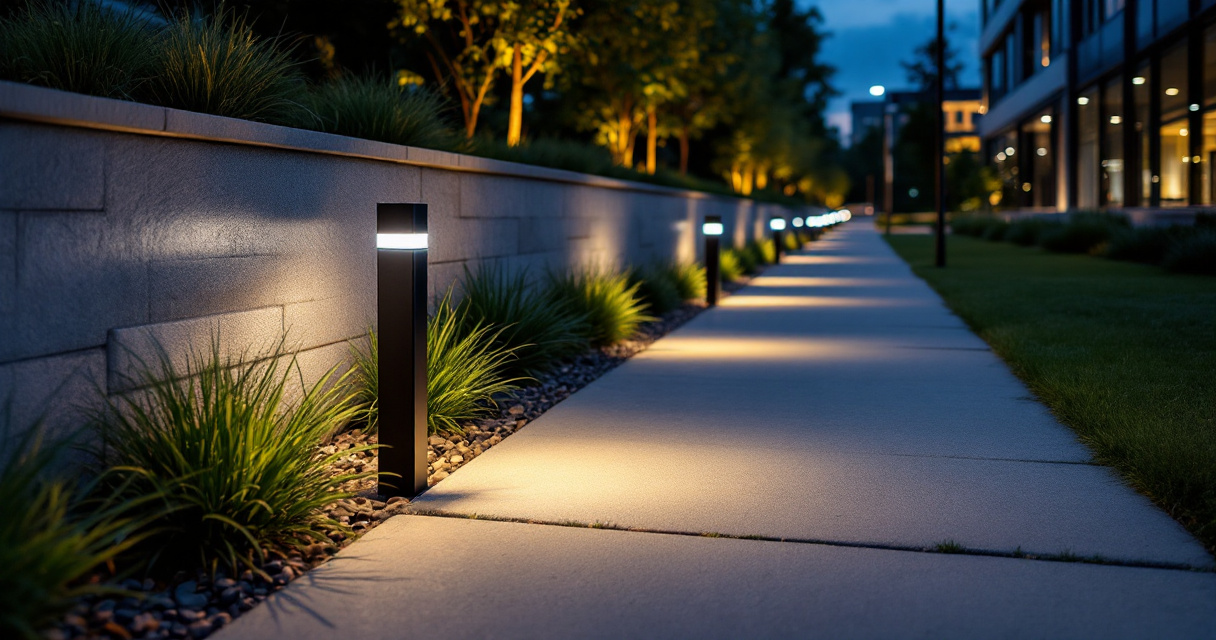
space and pathway lighting is part of landscaping, which Wikipedia defines as modifying visible features of land through design elements such as plants, terrain, and structures. Lighting becomes an architectural tool that guides movement while highlighting surrounding features.
Using guidance from resources like The JQZ Lighting Journal, contractors often select fixtures that balance illumination, durability, and installation cost for commercial environments.
Common LED Walkway Lighting Fixtures
Comparison of Popular Fixture Types
| Fixture Type | Typical Placement | Key Advantages |
|---|---|---|
| LED Path Lights | Along sidewalks and garden paths | Soft, downward illumination with decorative design |
| Bollard Lights | Commercial plazas and campuses | Durable, 360° light distribution for wider coverage |
| Wall Pack Lights | Building edges along walkways | Strong illumination with fewer fixtures |
| In‑ground LED Lights | Steps, edges, and space accents | Discreet appearance and precise light direction |
Each option serves a different role. Path lights highlight walkways, while bollards provide wider spacing and stronger durability for public spaces.
Accent Lighting for space Walkways
Some pathways benefit from subtle accent lighting, a lighting method that focuses illumination on specific objects or areas. Trees, sculptures, and architectural features often receive accent lighting to add visual depth to pedestrian routes.
Accent fixtures combined with path lights create a layered design. Instead of flooding the entire area with bright light, the lighting plan guides visitors naturally through the environment.
How to Plan LED Walkway Lighting for Commercial Properties
Lighting a walkway correctly requires more than installing fixtures at equal distances. Contractors evaluate foot traffic, surrounding structures, and surface materials before choosing a layout.
Facilities such as warehouses, hospitals, or office campuses often require consistent illumination along hundreds of feet of pathways. The goal is to avoid dark gaps while keeping energy use reasonable.
Step‑by‑Step Planning Process
- Assess pedestrian routes: Identify main paths between parking areas, entrances, and outdoor facilities.
- Measure spacing requirements: Determine fixture spacing based on lumen output and beam angle.
- Select appropriate color temperature: 3000K to 4000K often balances comfort and visibility.
- Plan mounting height and placement: Low path lights create atmosphere, while taller bollards improve coverage.
- Integrate control systems: Timers, photocells, or motion sensors reduce unnecessary energy use.
Contractors researching equipment options often reference product guidance available through The JQZ Lighting Journal when selecting commercial‑grade LED fixtures for outdoor installations.
Common Walkway Lighting Mistakes to Avoid
- Overlighting pathways, which causes glare and wastes energy
- Uneven fixture spacing, leading to dark patches
- Ignoring space growth, where trees later block light output
- Using residential fixtures in commercial areas, which often fail faster
Avoiding these issues during the planning stage saves significant maintenance costs later.
Energy Efficiency and Sustainability Advantages of LEDs
Energy savings remain one of the main reasons businesses switch to LED walkway lighting. LEDs convert electricity into light far more efficiently than older technologies, which reduces both operating costs and environmental impact.

Research on sustainability in the journal Sustainability (2021) examined strategies for reducing carbon emissions in institutions and highlighted energy‑efficient infrastructure as a major contributor to sustainability initiatives. Lighting upgrades often represent one of the fastest improvements organizations can implement. See the study: Achieving Sustainability and Carbon Neutrality in Higher Education Institutions.
Key Operational Advantages
| Feature | Benefit for Facilities |
|---|---|
| Long lifespan | Many commercial LED fixtures operate for 50,000 hours or more |
| Lower energy use | Reduced electricity costs compared with traditional lamps |
| Reduced heat output | Less strain on electrical components |
| Smart control compatibility | Works with photocells, timers, and motion sensors |
Property owners who install LED walkway lighting often notice improvements in both operational efficiency and nighttime visibility.
Switching to LED pathway lighting reduces maintenance cycles while improving illumination consistency.
Future Trends in Outdoor Walkway Lighting Design
Outdoor lighting technology continues to evolve, especially in commercial environments where energy costs and safety standards matter. LED systems are now being integrated with sensors, smart controls, and data monitoring.
Lighting design is also shifting toward pedestrian‑focused environments. Urban planners increasingly emphasize walkability and nighttime safety, which makes high‑quality walkway lighting more important for campuses, retail districts, and logistics facilities.
Emerging Trends to Watch
- Smart lighting networks that adjust brightness based on foot traffic
- Solar‑assisted LED fixtures for remote pathways
- Integrated security lighting that pairs pathway lights with cameras
- Adaptive dimming controls that reduce power use during low‑traffic hours
Many of these technologies are already appearing in commercial projects featured on The JQZ Lighting Journal, where contractors and facility managers explore modern LED installations and product innovations.
Conclusion
LED lighting has become the standard solution for outdoor walkways and pathways because it combines safety, efficiency, and design flexibility. Commercial properties benefit from brighter illumination, longer fixture lifespans, and lower operating costs compared with older lighting technologies. Proper fixture selection, thoughtful spacing, and smart controls ensure pedestrians can move safely while maintaining an attractive space.
If you're planning an upgrade or designing a new outdoor pathway system, reviewing product options and installation guidance through The JQZ Lighting Journal can help you choose commercial‑grade LED fixtures that meet safety and efficiency goals. Explore available lighting solutions, compare fixture types, and start planning a walkway lighting system that improves both visibility and long‑term energy performance.